Christ’s Christianity or Checklist Christianity – Walker Cain – August 09, 2026

In Admonition Podcast, Biblical Principles, Christianity, faith, God's Word, keywords Bible study, New Testament, Obedience, Old Testament, religious checklist, Spiritual Growth by Aaron Cozort

image

Have you ever had a to-do list?

You had your list of objectives, your list of things that you wanted to accomplish for the

day.

Maybe it was at work and the first day the boss said every single employee here needs to

have a to-do list so that everyone got done what they needed to do.

Maybe it was an instructor at college that said, Listen, if you do this, you are going to

have a head start in your work.

At at Memphis we had an instructor who one of our assignments was to say whether or not

that we had a checklist of the things that we wanted to do each day.

We are used to the idea of to-do lists or checklists.

Now they have strengths.

What what is it that a checklist provides for you?

Well, it can give organization.

You know what you need to do.

You know the order in which you need to do it.

It can be something great, something beneficial.

Well, what are the weaknesses?

Well sometimes we can put a little bit too much on our checklist.

We don’t we don’t have all the information in the world.

We don’t know how much time we’re going to have or what’s going to come up.

So there can be times that our checklist has too much on it for what we can really do.

There’s other times it can have too little where we realize, you know what, I could do

more today, and then we add to it later.

But a checklist can have too much, it can have too little, and also another weakness of a

checklist is usually it doesn’t tell you.

why you’re doing what you’re doing.

You know that you need to get this done today, but it’s it’s going to be rare to find a

checklist that says, I need to do this, and here’s the reason why.

Now a checklist can be fine for work.

It is something that is extremely useful, beneficial, and it’s something that we can use

and it’s an expediency, even in our service as Christians.

But what we need to ask is if we use a checklist or if we use the Bible.

If we go to God’s word or if instead we use some kind of summary that we’ve made for

ourselves, the Jews themselves were guilty of this.

Looking at the Jews, Matthew chapter four verses twelve through seventeen, Jesus came to

this earth, he was baptized, he was tempted in the wilderness, and he was about to start

his ministry, or he was starting his ministry.

Verse twelve Now when Jesus had heard that John was cast into prison, he departed into

Galilee, and leaving Nazareth he came and dwelt in Capernaum, which is beyond the sea

coast, in the borders of Zebulun and Neftalim.

That it might be fulfilled which was spoken by Isaiah the prophet, saying, The land of

Zebulun and the land of Neftalim by the way of the sea beyond Jordan, Galilee of the

Gentiles, the people which sat in darkness saw a great light, and to them which sat in the

region in shadow of death, light is sprung up.

From that time Jesus began to preach and to say, Repent, for the kingdom of heaven is at

hand.

The Jews were supposed to be the people who had the word of God.

They had light.

Paul in the book of Romans would ask, What advantage then hath the Jew?

And he would show, Listen, you have God’s word, you have that advantage.

They had what they needed, not to be in darkness, but also they were in darkness anyway.

Now they didn’t know everything about the Christ that would come, and on top of that, they

had leaders who were hiding the truth from them, or were not teaching the truth to them.

They instead had leaders who said, This is what our rabbi says, so this is what we are

going to do.

This is the tradition of our fathers, so here’s what we’re going to do instead of

following the old law.

In fact, you know what?

It’s not that we’re not following the old law.

We’re just doing things that help us follow the old law.

When what they were really doing was replacing the law of Moses with what man wanted to

say.

They tried to take a to-do list, a checklist that they had made, that man had designed,

and replace God’s word with it.

In the best case scenario, they just tried to make that a useful piece of

of their religion, when what it really did was distract from what they needed to be doing,

following God’s word.

Christ came bringing change, bringing a light, and he was going to change it from being

this faulty way of looking at the old law, of looking of w at what God had said, and he

would also bring the church as well, which was his main goal, saving souls and building

his church.

But looking at Christ’s ministry, we want to focus on it for just a second on the side

before

The New Testament starts, of the teaching he was bringing them then.

Matthew chapter five, verses one through two.

These verses show Christ starting the Sermon on the Mount.

And Matthew five through seven, that is the Sermon on the Mount, and it’s going to show

some of the greatest change you could ever see, or some of the greatest change seen in

what Christ taught the people.

As we saw in Matthew 4, he was teaching them repentance.

Matthew chapter 5, he showed them in many respects how to repent.

He’s it starts with blessed are the poor in spirit.

And when usually they would think, blessed are those who are rich, blessed are those who

have what they want.

And all these other aspects, Christ is going to show them something that turns their world

upside down.

Now, with that idea of turning their world upside down, was it the fact Christ was

changing their law or changing the way they looked at it?

Something that needs to be kept in mind here is Christ was during the Sermon on the Mount,

Christ would say many things such as, You have heard it said, an eye for an eye, and a

tooth for a tooth.

But then Christ showed that they were supposed to turn the other cheek.

Was this Christ contradicting the old law?

When he says, Ye have heard it said that he who looks on a woman commits adultery.

But but I say unto you,

Whoever looks on a woman to lust after her hath committed adultery already in his heart.

When Christ said that, was he contradicting the old law?

Was he adding to what the Lord had said?

The Lord was not changing the law.

And certainly he wasn’t changing it yet.

We know this because the law wasn’t going to be done until it was nailed to the cross.

Colossians 2 14 says that Christ had what he did blotted the handwriting of ordinances

that was against us.

Which was contrary to us, and took it out of the way, nailing it to the cross.

So during Matthew chapter 5 through 7, Christ isn’t implementing the new law.

He’s still under the old law.

Whatever he is showing them is not a change in the law they are following.

Looking at those words when Christ says, Ye have heard it said, but I say unto you, we

could translate that but with and.

What Christ was doing was looking at the way they looked at the old law.

the way they looked at it as a checklist, and was saying, You know what, this is what you

should have been doing all along.

Further looking at the fact that Christ was not teaching them something new, he said

himself in Matthew five, seventeen through nineteen, Think not that I am come to destroy

the law or the prophets.

I am come not to destroy, but to fulfill.

For verily I say unto you, till heaven and earth pass, one jot or one tittle shall in no

wise pass from the law

Till all be fulfilled.

Whosoever therefore shall break one of the least of these commandments and teach men so,

he shall be called least in the kingdom of heaven.

But whosoever shall do and teach them, the same shall be called great in the kingdom of

heaven.

What Christ was teaching were principles that were going to apply both under the new law

and the old law.

But keep in mind, right here he says he came not to destroy the law, but to fulfill.

And then he says,

Not one tittle of the law would pass until all was fulfilled.

And we saw Colossians two fourteen earlier that said when Christ was nailed to the cross,

that’s when that handwriting of ordinances was no longer was nailed to the cross or no

longer under it.

It’s no longer the system by which God judges the people of this earth.

The law was going to change then, but it still had not changed yet.

Which means the Chr what Christ is showing them is not a change in the law, but in how

they looked at the law.

He tells them, Don’t think I’m trying to change the law.

Don’t think I’m trying to destroy the law.

I came not to destroy, but to fulfill.

Everything Christ taught them could apply to the old law.

Which means what they were doing was not w which means Christ was not correcting the old

law itself, but how they looked at it.

Now this happened to the Jews.

This happened to the people who had the words.

They had the scribes who were copying the words as their life’s goal.

If it could happen to them, could it happen to us?

Could we take the scripture of God and instead of looking at it for what it says,

following it for what it says, could it be that we need to step back and ask, are we

following God’s word or are we following a checklist, a to-do list we make that we think

is based on God’s Word?

But where we’re but it’s not quite from there.

That’s not quite the source of it.

A checklist can be a good thing, but it can also be bad, and it is always going to be a

bad thing if it is used in religion rather than scripture.

It’s always going to be bad if it’s used instead of looking at God’s Word.

Today we are under the New Covenant.

We are under the covenant of the New Testament.

We have a new law.

Hebrews 9 15 says, And for this cause he is the mediator of the New Testament, that by

means of death were the redemption of transgressions that were under the first testament,

that which are called might that they which are called might receive the promise of

eternal inheritance.

We have the new law now.

Christ is the mediator of the New Testament.

If they needed to be careful about how they looked at the Old Law, how much more should we

be careful in looking at Scripture and looking at the New Law, the better law that we

have?

Today.

We’re going to ask some look at a line of reasoning when it comes to these this checklist

idea.

First, if we follow a checklist, then we follow something other than God’s plans.

If we follow something that we have written ourselves, even if we haven’t realized we’ve

written it, we follow something that is not God’s word.

Second Timothy three, sixteen and seventeen.

All scripture is given by inspiration of God and is profitable for doctrine, for reproof.

For correction, for instruction in righteousness, that the man of God may be perfect,

thoroughly furnished unto every good work.

We have this saying that all Scripture is profitable, but also connect that with

Revelation, chapter twenty two, verses eighteen and nineteen.

For I testify unto every man that heareth the words of the prophecy of this book, if any

man shall add unto these things, God shall add unto him the plagues that are written in

this book.

And if any man shall take away from the words of the book of this prophecy, God shall take

away his part out of the book of life and out of the holy city from the things which are

written in this book.

Now it needs to be kept in mind that this passage in Revelation is in Revelation.

This is about the book of Revelation itself.

But the principle applies to the whole of Scripture.

If we add to it, the curses that the Scripture shows against those who add to God’s word,

they’re going to come against us.

If we take away from it,

The promises God has for those who follow His Word, they will be taken away from us.

God is going to be just in how He treats that.

But now looking at this in conjunction with Second Timothy three, sixteen and seventeen,

you have the holy word of God, which is perfect for all.

But then you have the fact that if we add or take away from it, we’ve done something

wrong.

If we follow a checklist rather than God’s word, we can be following too little.

Even if it’s a part of God’s word, but not all of God’s word.

It’s not going to work.

It’s God is not going to accept it.

We read earlier Matthew 5, 17 through 19.

Verse 19 again says, Whosoever therefore shall break one of the least of these

commandments and shall teach men so, he shall be called least in the kingdom of God.

Whoever breaks the least of these commandments, there’s going to be consequences for it.

Whoever doesn’t pay attention to what God has said, there is going to be repercussions

because of it.

Now the Lord is not looking down and waiting to strike us for anything we’d possibly do

wrong.

We’ll look more into the idea of how great our God is and how He doesn’t do that later on.

But Christ was showing the fact that they the details mattered.

The fact that they followed this law mattered and they could not leave out what God was

saying.

Even if it was uncomfortable, even if it took extra time.

What God wanted them to do was what God wanted them to do.

We can’t take the great commission out of Scripture.

And pretend like we’re following God’s way.

We can’t take God’s command to meet and gather as the church and worship Him and pretend

like we are following God’s religion, following God’s way.

If we do not do as He says the way He said it, if we’re doing too little, there’s no way

that God will accept it.

A checklist can be too little, but a checklist can also be too much.

Paul would write in 1 Timothy, starting in verse 1.

First Timothy verses one through five.

Now the Spirit speaketh expressly, that in the latter time some shall depart from the

faith, giving heed to seducing spirits and doctrines of devils, speaking lies and

hypocrisy, having their conscience seared with a hot iron, forbidding to marry and

commanding to abstain from meats which God hath created to be received with thanksgiving

of them which believe and know the truth.

God is showing that there are these who would come and they would have lies.

They would speak lies and hypocrisy and they would forbid to marry.

They would ab command people to abstain from meats.

They were commanding people to do things that God had not commanded himself.

You can have a checklist that has too little.

You can also have a checklist that has too much.

A checklist that says, you know, God didn’t say this, but we’re going to command it.

There’s a religion out there that

For hundreds of years has said, You can only be a priest of God if you never marry, if you

are celibate.

Well, they’ve never looked at God, they’ve apparently never looked at God’s word and saw

marriage is honorable and all in the bed undefiled.

They have added to God’s word.

And then that same religion wants to talk about Good Friday, wants to talk about not

eating meat, when God shows here specifically that there would be those that would come.

And would command to abstain from meats.

Now this applies to far more than any single denomination.

In fact, this applies more than just in the fact that there are there’s the commands to

abstain from meats that some people have, the commands to abstain from marriage that some

give.

If we put more on the brethren than what God’s word says, then we are hurting him.

If we condemn people for things that aren’t really God’s word but are just our culture,

Then there is going to be punishment because of that, because we follow lies and hypocrisy

as well if we do that.

We can have too little in our checklist, we can have too much, but also if we follow a

checklist instead of God’s word, it can be something entirely different from what God

commands us to follow.

Romans ten one through three talks about the Jews having a zeal for God, but not according

to knowledge.

They had a zeal for the Lord.

It’s not that they had a zeal for an idol, they had a zeal for God, but they didn’t know

how to serve him.

The way they were to serve him was now under the new law.

Colossians 2 14, the old law was nailed to the cross.

They were still following it.

The Israelites were still following that old way when it was entirely different from what

God commanded.

Again, if we follow what we think is right, if we follow our own to-do list rather than

the Word of God, it can result in us following something entirely different from what God

desires.

And that’s when we end up with religions that look like mythology.

That’s when we end up with tasks that we don’t know where they came from in Scripture.

God has given us a simple commands.

Simple commands.

He’s commanded us to be with one another as Christians, to edify one another, and to go

out and preach the gospel to others, being benevolent to the world outside.

God’s commands are simple.

He commands morality of us as well.

But when we add to it or when we entirely change it,

Even if we stick God’s name on as a label on whatever we’re doing, it’s not going to

change it if it is not from Him.

If we follow a checklist, then we follow something other than God’s plans.

Now, keep that in mind.

If we follow a checklist, then we follow something other than God’s plans.

Well, it then follows if we follow something other than God’s plans, we don’t follow God.

So then if we’re following a checklist, we have to ask, what is it we’re really following?

If we are doing too much, too little, or something entirely different, what is it that is

truly our goal?

What is it that we are truly serving?

It could be that we’re following what we’ve always heard.

Matthew fifteen, verses two and three.

Christ has the Pharisees come up to him and they ask, Why do your disciples disobey the

tradition of the elders and eat with unwashed hands?

And Christ shows them the fact that they are transgressing transgressing the law.

Why do ye also transgress the commandment of God by your tradition?

And then go Christ is going to show that they different ways in which they undid the law.

They changed the law because they didn’t want to do it, and instead added their own

interpretations, additions, or subtractions to God’s word.

But keep in mind he says, they say

Look, we have the tradition of the elders.

This is what we’re supposed to do when Christ says you disobey God’s command by your

tradition.

If we follow what we’ve always heard, we can be in danger.

If we go to worship service because mom and dad said so, or because that’s what religious

people do in America, instead of doing it because that’s what God’s word says, we might be

following a to-do list rather than what God has told us to do.

If our

purpose is not centered on him, but rather centered on what we’ve heard.

Even if we think it’s right, it can be entirely wrong.

It’s a good thing to wash your hands before you eat.

That wasn’t a bad thing for them to say, but what was wrong was for them to bind it as

though it was something from God.

What man says, unless he is quoting Scripture or he is making a necessary inference from

Scripture, is never as powerful as Scripture itself.

That it is never going to be something

That we need to weigh as heavily as Scripture.

We might be following what we’ve always heard, but we could also be following wayward

priorities.

Matthew fifteen verses Matthew twenty three, sixteen through twenty four, rather.

Christ is also going to show another way in which the Pharisees were following wicked

ways, of following their own desires.

Starting in verse sixteen Woe unto you, ye blind guides, which say, Whosoever shall swear

by the temple, it is nothing.

But whosoever shall swear by the gold of the temple, he is a debtor.

Ye fools and blind, for weather is greater the gold, or the temple that sanctifieth the

gold.

And whosoever shall swear by the altar, it is nothing, but whosoever sweareth by the gift

of upon the altar, he is guilty.

Ye fools and blind, for weather is greater the gift, or the altar that sanctifieth the

gift.

They said, We have the temple, we have the gold.

And the gold’s more important.

The part that makes us rich, that’s what’s important.

What’s more important, the altar or the sacrifice?

The sacrifice that the priests get to eat a little part of, that’s the important part.

They took the part that was more valuable to them that could benefit them and said it was

more important than the part that was more tied to the Lord Himself, to His commands of

what to build, of what to make to worship Him.

Now it’s the fact that they were commanded to give these offerings, to have the gold in

the temple, but they had gold that was bea beyond what God had commanded.

They had the donations that were given.

By the rich and even the poor, but they made these riches and they made these temporal

offerings more important in their religion than the temple itself.

It can be the case that there are times where we make things more important rather that

God never even said a thing about.

It can be the case that we look at the church building and think, This is the sanctuary.

When God says, go and meet

And they met in each other’s houses in the New Testament.

Frankly, the auditorium, it was never called a sanctuary in Scripture.

It’s just as good as any other building to go and worship.

It is simply a place where we meet.

But with that, are there times where we make the building more important than God did?

Or we go and make any other physical aspect.

We go make the bank account more important than the work of the Lord.

This congregation does not do that.

This congregation goes

and supports and make sure that it’s following God’s word and thank you for that.

But there are many who hold on to the mighty dollar rather than looking for what our Lord,

our deity, desires of us to do with the funds He has given us.

Because they value this world’s goods more than the g work that can be done with this

world’s goods.

If we follow a checklist, then we might be following what we’ve always heard.

We might be following

our own priorities, or we could follow what makes us look righteous.

Christ in Matthew chapter six, three different times, is going to tell the Pharisees, You

have your reward already.

Matthew six, verse two Therefore, when thou doest thine alms, do not sound a trumpet

before thee as the hypocrites do in the synagogues and in the streets, that they may have

glory of men.

Verily I say unto you, they have their reward.

They took something that was a good and godly thing.

Going and spreading good goods to the poor, but they made it a tradition of making pe

having people look at them, of saying, look how righteous I am.

And then Christ told them, You have your reward already.

When those people looked at you and said, man, look at the good he’s doing, they already

had their reward, and there was nothing left good for them to receive from it.

Christ is going to say this again in verses five and sixteen.

But skip over to Matthew twenty-three, twenty-five through twenty-eight.

Matthew twenty-three, twenty-five through twenty-eight.

Woe unto you, scribes and Pharisees, hypocrites, for ye make clean the outside of the cup

and platter, but within are full of extortion and excess.

The Pharisees were guilty of making the outside of the cup cup look like it sparkled,

while the inside was dirty.

Imagine bringing that to a fellowship meal.

You had a dish where it was sparkling on the outside.

But before that beautiful brownie dessert was put in, there was a casserole that should

have been washed out maybe about a week ago, still around the edges.

How many people are going to enjoy eating that?

It’s not going to happen.

The Pharisees were like that.

They were like a dish where it had been able to stay and stink, and then the next thing

put in it, no one’s going to want that.

God certainly doesn’t.

If we do what makes us look righteous rather than what is righteous, it could be that

we’re just following a checklist of, okay, do I think this is going to make me look

righteous rather than, okay, what has God said is righteous.

We can follow what makes us look righteous or what makes us feel righteous.

Earlier we referenced Romans ten verses two and three.

They have a zeal for God.

They have a genuine sincerity to follow Him, but not according to

To righteousness, not according to knowledge, rather.

Verse 3, for they being ignorant of God’s righteousness, and going about to establish

their own righteousness, have not submitted unto the righteousness of God.

If we follow a righteousness that we’ve established for ourselves, if we follow a rule

book that we’ve made, or a rule book that is obsolete, as the Jews did, even if it’s with

full sincerity, then it’s still something that God cannot accept.

Even though he desires all men to be saved, he by his very nature is required to be just.

We must ensure that what we follow is his word, is his will.

Rather than following what makes us feel righteous, we must follow what makes us

righteous.

Ezekiel chapter eighteen, verses eighteen and nineteen show that a man he is going to be

counted righteous if he does what’s righteous.

The one who does iniquity, he will be counted as wicked for his wickedness.

God is going to judge righteous those who do what is right, but for us to know what is

right, we need to know His word in His way.

If we follow something other than God’s plans, we don’t follow God.

So what is it that we follow?

It could be what I’ve always heard, it could be wayward priorities, it could be what makes

me look righteous or feel righteous, but a final idea.

If I follow something other than God’s plan,

It might be that I’m just going through the motions.

Hose Hosea verse six of chapter six.

In describing his judgment against the Jews, God says, For I desired mercy and not

sacrifice, and the knowledge of God more than burnt offering.

They were offering things to God.

They were giving him of offerings, but God says, I desired mercy and

And not sacrifice.

This word mercy is translated as kindness and goodness.

It is something that is from it is a characteristic of God Himself.

Exodus 34, 5 and 6 shows that the first personality trait shown of God is his mercy.

God desired mercy.

He desired for man to have a characteristic of him more than he did sacrifice.

And then he desired knowledge of God more than burnt offering.

When God gives us

His commandments.

God’s commandments are important.

Let there be no doubt about that.

The Ecclesiastes, the ecclesiastical writer said, Fear God and keep His commandments.

He said, That is the whole of man.

But we need to remember why we follow God’s commandments.

God says he desires mercy and not sacrifice.

He desires something more than just following the written commandments.

There’s a motive behind it.

What’s the greatest commandment?

Thou shalt love the Lord thy God with all thy heart, all thy soul, all thy mind, all thy

strength.

And the second is like unto it, thou shalt love thy neighbor as thyself.

You can have all of the things right.

You can have every single check mark done.

But if you don’t have the motive behind it, then it is nothing but a checklist.

It’s not God’s word.

It is not his way.

He desires mercy and not sacrifice.

His commandments, in and of themselves, are designed for us to grow closer to Him, to

become more like Him, and to grow in our love for Him.

He desires mercy, for us to have the same kind of mercy He does, not sacrifice.

He desires knowledge of God, for us to know more and more about Him, not just the burnt

sacrifice itself.

God gave those sacrifices so we would understand what it meant to give something, because

He was willing to give His Son for us.

Every single aspect of what God has done.

shows us more about who he is and why we follow him and why he is such an amazing and

great God.

But if we don’t follow him so we can grow closer to him, we have to ask, what is it that

we follow?

Brethren, if we follow God’s word in God’s way and we aren’t growing closer to him, if we

are not following him and growing in our love for him, then we’re either we either need to

Step back and follow Christianity for what it was designed to do, or stop following the

lie we have fed ourselves entirely.

If we are not growing closer to God, we have missed the entire aspect of why God gave us a

law in the first place.

We cannot just follow it.

We cannot just go to church on Sundays and Wednesdays.

We need to look at God’s word and say, I want to grow closer to Him, so I’m going to do

what He says, how He said it, the way He said it.

And if we do that, our Lord is merciful and gracious, and we might mess up occasionally.

There might be something we don’t quite get right, but if we are striving to follow him

and we do follow his word, then he is going to say, Well done, thou good and faithful

servant.

Our Lord desires us to desire him.

That is the heart of what he desires of us.

That is the greatest commandment.

If we follow a checklist, we miss

the beauty of what he has shown us.

But if we follow his word, if we do as he says for the reasons he has given us, then we

can be sure that we one day will have a place with him in eternity, because we desired him

on this earth, and then we will truly have him in the life to come.

If we follow a checklist, we follow something other than God’s plans.

If we follow something other than God’s plans, we don’t follow God and we’ve asked what is

it we could we could be following instead?

But looking at that, if we follow a checklist, we don’t follow the Lord.

Therefore, we must put away the checklist and hold to the Word of God.

Otherwise we follow a lie.

Otherwise we follow something that makes us feel righteous, seems like we’re doing what is

right, but is only going to end

In damnation.

We must hold to God’s word for what it says.

John 14, 15, if you love me, keep my commandments.

Now, this love is important.

This love is the very basis of it all.

But remember, those commandments are the way we express our love to God.

Humans have a love language, a way that they desire for love to be shown.

Some love having gifts.

Some want that physical touch from their spouse.

There’s different kinds of love languages.

What if spouses said, no, I’m going to choose your love language today?

It’s not going to be what you did what you said it was.

Is that going to go well?

The Lord has shown his love language.

And his love language is has he is d how he has described himself in his word.

We can’t say, Oh, I’m going to worship God the way I want to, and access expect him to

think that that is love.

Because love says, what is it that you need?

What is it you desire?

I’m going to do that.

Our Lord looks at us, and even when it might not be something we desire, he gives us what

we need.

God desires us to look at him and give him what he desires, what he wants of us.

Now there is nothing that God needs of us, but he has invested his son, Christ Himself,

into us being saved.

God wants you.

Like he needs you.

Even though he is going to exist and be perfectly fine without you, he has invested his

son’s life into you.

That’s how much he loves you and wants you.

Why follow a checklist when there is such a Lord wanting you with him for eternity?

The commands matter, but also the motive does.

Mark twelve, thirty and thirty one, as we described earlier, thou shalt love the Lord with

all thy heart, all thy soul.

All thy mind, all thy strength.

The Lord desires you.

He desires all of you.

And if we give him that, if we truly follow his word in his way, then he is going to

accept us.

He is going to look at us with love and happiness because we’ve done as he says and we can

be with him one day.

Do we follow Christ’s Christianity, a one that’s does as God says

For what he said, how he said it, or do we follow a checklist?

Brethren, today we we pray that we follow Christ’s.

But if we do not, if there is a discrepancy in the way that we live, the opportunity is

now here to say, you know what?

The Lord has shown me how I need to live.

The Lord has given us his word, so I want to live it for how why he said to live it, or do

as he said if I’ve strayed from his commandments.

If you’ve gone from his way as a Christian, the Lord desires you to come to him.

But if you are not a Christian, if you have not went to his word yet, if you have not

submitted to his word, then grant you salvation until you are willing to accept it.

If you are in need of the forgiveness of God today, would you please come forward as we

stand and as we stand?

Loving As A Servant – Aaron Cozort – August 09, 2026

In 1 Corinthians 13, Admonition Podcast, Biblical Love, Christian living, Christian Principles, Church Disputes, Judging Others, keywords Love, Selflessness by Aaron Cozort

image

We’ve spent some time in the last few weeks discussing the things love is not, the things

love does not do.

We’re going to continue that this morning as we open to 1 Corinthians chapter 13, and I

encourage you to have your Bibles open, to go with me through the book of Corinthians,

because Paul, as he’s writing about love, we’ve mentioned this before and we’ll say it

again.

He’s not writing about love.

In the abstract.

He’s not writing about love from a dictionary perspective.

He’s not just defining what love is.

And he’s not writing about love in a specific context of marriage or of families.

He is writing in a specific context of love in the body of Christ.

He is writing about love as a comparison and a contrast to the miraculous gifts that the

first Corinthian church or the first century church in Corinth had received miraculously

by the laying on of the apostles’ hands in the first century.

And they were emboldened in their view of themselves because of these miraculous gifts.

Because they had the ability to speak in tongues, because they had the ability to

prophesy, because they had the ability to do these things that God had given them the

ability to do, and yet they had left off love.

And yet, when Jesus is answering the question concerning what is the greatest commandment

in the law, he doesn’t give an explanation concerning.

How to perform a a sacrifice on the altar.

He he doesn’t establish the laws and the ordinances of the Old Testament law in all of

their 613.

He dials straight into Deuteronomy chapter 6 and says, Thou shalt love the Lord thy God

with all thy heart, with all thy soul, with all thy strength, and with all thy mind.

And the second is like unto it, thou shalt love thy neighbor as thyself, on these two hang

all the law and the prophets.

And so Paul, as he is writing to the church at Corinth, will begin by describing how if

they have all of these miraculous gifts, as he opens the chapter.

And they do not have love.

They’re nothing.

He writes to them in chapter 13, verse 1 of 1 Corinthians Though I speak with the tongues

of men and of angels and have not love, I have become a sounding brass and a clinging

cymbal.

And though I have the gift of prophecy and understand all mysteries and all knowledge, and

though I have all faith that I could remove mountains and have not love, I am nothing.

And though I bestow all my goods to feed the poor, and though I give my body to be burned,

but have not love, it profits me nothing.

He says, I have produced nothing.

I am nothing, and I have gained nothing.

Verse 4, he writes, Love suffers long and is kind.

Love does not envy, does not parade itself, is not puffed up.

We looked at that two weeks ago.

But he also says love does not behave rudely.

We noticed that last week.

That is to say, love refuses to cause others to be put down so that I might be put up.

It refuses to humiliate.

It refuses to dishonor.

And as we’ve gone through these lessons, we’ve noticed in the first twelve chapters of the

book of First Corinthians, Paul has.

Described where the church at Corinth is actively doing every single one of these things.

They have within their membership those who are behaving dishonorably toward their

brethren.

But he goes on to say: love does not behave rudely, does not seek its own, is not

provoked, thinks no evil.

That’s where we’re going to spend our time this morning.

Love first does not seek its own.

As Paul writes to these Corinthian brethren, as he writes to them about this fundamental

character of God.

See, John would write to the first century church, and John would say, God

is and he doesn’t finish that with speaking in tongues.

He doesn’t say God is prophecy.

He doesn’t say God is knowledge.

He doesn’t say God is faith.

He says God is love.

Paul says, love does not seek its own.

The definition here literally is does not seek the things of itself.

In other words, it does not look at itself and say, you know what?

I am going to care exclusively and with the highest priority about me.

Now,

This is certainly not to say, and is no biblical context to say, that love does not care

for oneself.

Because if that was true, then Jesus’ statement in the second describing the second law in

the old testament law would mean nothing.

Because didn’t he describe it as thou shalt love thy neighbor as thyself?

So

Love, in view of this, in this context, does not mean it has no consideration for itself.

That’s not the point.

Rather, that it does not seek its own.

There’s an active action here in seeking.

This is to desire and to motivate oneself to passionately fulfill.

Every desire you have for yourself.

Paul says love doesn’t do that.

Love doesn’t enumerate all of the things that you are interested in and that you value and

you want for yourself.

And now it doesn’t matter what happens to everybody else.

We’re going to do those things.

Love refuses to make itself the center.

Love asks what is best for someone else, for the other person.

In Roman chapter five.

Paul, as he’s writing to the church at Rome, will describe the nature of God’s love.

As he writes, beginning in verse 6: For when we were still without strength in due time,

Christ died for the ungodly.

For scarcely for a righteous man will one die, yet perhaps for a good man, someone would

even dare to die.

But God demonstrates his own love toward us.

Notice the direction of love.

God is love, and the direction of his love is toward us.

Paul says if you have love and your love is entirely self-centered.

That your desires and your passions and your movements and your your energies are all

focused entirely on you.

Then what you have is not love.

Because love doesn’t seek its own.

Love is motivated toward someone else.

But notice the rest of the text.

Paul says God demonstrates his own love toward us in that while we were still sinners,

Christ died for us.

You see, God exemplifies this in sending his son to die on the cross for our sins.

What did Jesus say when he was speaking to Nicodemus in John chapter 3?

For God so loved the world that he gave his only begotten Son.

That whosoever notice all of the directional statements in that verse.

It was motivated not for God’s concern for Himself, but God’s concern for the world.

It involved sacrificing self for the benefit of the world.

It involved creating a path of salvation for the world.

Love does not seek its own.

It says what is best for you instead of what do I get?

But then consider some examples where Paul draws home the problem in the church at

Corinth.

In First Corinthians chapter six.

We read and in verse 1, Paul writes to the church at Corinth, and he says, Dare any of you

having a matter against another go to law before the unrighteous and not before the

saints?

Here’s the scenario.

You have the church at Corinth, which is growing.

Which is made up of Jews and Gentiles, which is made up of those who, some of whom were

taught directly by Paul, some who have been taught by other teachers along the way.

And within this congregation, you have individuals who have businesses.

They they have endeavors that they’re involved in in their daily lives.

And perhaps the scenario may come where one member of the church does business with

another member of the church.

But as they’re accounting for the business that they’ve done, they realize, you know what,

you didn’t do me right.

You you didn’t get do what you said you would do.

You didn’t give me everything you sold me.

You sold me this much of something, but you delivered this much of it.

And so here are these two members of the body of Christ, and they’re saints.

They’re Christians.

And one of them is saying, listen, you didn’t handle this relationship properly.

And so instead of dealing with it together, instead of dealing it with it in the body of

Christ, this member of the body of Christ says, You have not handled this properly.

You have not delivered what you said you would.

I’m going to go take you to the court in Corinth until you pay me everything you owe me.

Something to observe in this as we go through the text is Paul never says that the person

who’s bringing the case isn’t justified in bringing the case.

He never says that the one who did wrong to his brother didn’t actually do wrong to him.

Rather, Paul’s addressing it on a deeper level about the motivation in the heart of the

one who’s taking his brother to the courts.

Notice what he says.

He says, Do you not know that the saints will judge the world?

First thing that Paul wants to address is do you not realize what the scripture and what

prophecy has said concerning those who belong to God?

You go all the way back to the life of Noah.

And you find there as the Bible speaks concerning Noah, that not only did Noah find grace

in the eyes of the Lord, but Peter will write concerning Noah that through Noah’s life he

preached righteousness, he judged the wicked world that he lived in.

Paul says, Do you not know that the people of God judge the world?

Do you not comprehend that as a Christian you stand in judgment of the world by your

obedience to Christ?

But then he goes on to say, and if the world will be judged by you, are you unworthy to

judge the smallest matters?

Here you are.

You are a Christian.

You are declaring that the world is lost, that the world is in sin, that the world is in

danger of eternal judgment by your actions, by your life, by your faithfulness to Christ.

You can judge in the single greatest, most weighty matter that there is eternity.

And are you telling me that as a Christian you can’t judge on a matter of business?

You can judge the world that they’re in sin.

You can judge the world that they stand condemned before God, but you can’t judge whether

one Christian or another Christian is right on a matter of business?

He says, Do you not know that we shall judge angels?

How much more things that pertain to this life?

Paul makes it clear that as a Christian, as a person living in this world who has received

the gospel, he says, you stand in a position of honor and judgment even before the angels

in heaven.

Consider what Jesus would say and what Paul would point out.

Even the angels believe.

They know who Jesus is, they know what his what authority he has.

But those who follow Satan, they know it doesn’t mean they obey him.

Paul says, You’re going to stand in judgment before angels as one who has been obedient to

the message of Jesus Christ.

So you can judge the world and you can judge the angels.

How is it you can’t be considered wise enough and faithful enough to the Word of God to

judge on a matter of this life?

He goes on to say, verse 4 If then you have judgments concerning things pertaining to this

life, if you’re seeking a judgment, you have a matter.

That needs to be judged.

But it’s not about eternal matters, it’s not about spiritual matters.

It’s about a matter in this life, he says.

If then you have judgments concerning things pertaining to this life, do you appoint those

who are least esteemed by the church to judge?

You’ve got a matter you need to deal with.

I tell you what, I know that that judge worships at the altar of Zeus, and I know that

that judge goes out and commits fornication with the worshipers of the altar of Zeus.

And I know that judge is dishonest and accepts bribes, but here’s what I’m gonna do.

I’m gonna take my matter that I have with my brother in the body of Christ, and the two of

us, Christians, are gonna go stand before that judge to get him decide on a matter.

Paul says, I say this to your shame.

Is it so that there is not a wise man among you, not even one who will be able to judge

between his brethren?

Moses, look over the congregation.

Look around you in the body of Christ.

Can you not find one man who’s got any wisdom?

Can you not find one Christian with a shred of wisdom, so much so that they would become a

Christian, and they are therefore in a better position to judge matters of morality and

rightness and justice than the world?

Can you not find a Christian who can judge on this matter?

But brother goes to law against brother and that before unbelievers.

Paul says, I’m going to declare this as shameful as it is.

He says, No.

Sorry, verse seven.

Now, therefore, it is already.

Look at this language that Paul uses.

He’s used shame, unbelievers, and he says, now it is already an utter failure, as the New

King James translates it.

You have missed it in every degree at every point.

In this scenario.

He says it is already an utter failure for you that you go to law against one another.

Now here’s the question.

Here’s the position where we draw back to love does not seek its own.

Paul says, why do you not rather accept Rome?

Paul says, if you were to give me the option, am I going to take another person in the

body of Christ, a Christian, and in perspective of that, the reputation of the body of

Christ, and take it before a judge.

To allow an ungodly judge and an unrighteous person to declare one who is my brother and

by reputation the church to be an ungodly entity, an unjust entity, someone participating

in wrong.

He says, if you give me that choice or the choice to accept wrong done against me, I’ll

tell you which I’m taking.

You do wrong to me all you want, but don’t you dare do wrong to the church.

Don’t I dare do wrong to the church by taking it before a judge?

He says, Why do you not rather accept wrong?

Why do you not rather let yourselves be cheated?

No, you yourselves do wrong and cheat, and you do these things to your brethren.

Notice Paul’s not letting the guilty party off.

Paul is in no way allowing the guilty party who has done this to get away with it.

Paul needs to address first their heart.

And by the way, one of the things that you see here is you see a scenario very similar to

the wicked servant.

You remember the parable that Jesus gave?

The king had a servant who owed him a great debt.

A debt so large he would never be able to pay it.

And he brings the servant before him and he says, You’re going to have to be vanquished uh

vanquished, your your your family’s gonna be sold, we’re going to regain everything we

can, fire sale, this servant gone.

And the servant says, Give me time, give me time, and I will repay all of it.

And the king, knowing it is impossible for the servant to ever pay the debt, forgives the

debt.

The servant then, having been forgiven, goes out, finds a servant who owes him money.

And turns around and takes the servant who’s under his authority and throws him in prison

and says, You’re not getting out of prison until you pay me every penny.

had authority.

So the king calls for the servant who he had forgiven.

When he sees what the servant has done, what did I forgive you?

You had a debt you could never have paid.

And now you go and hold someone guilty and will not forgive a debt which they could have

paid?

Here’s a Christian.

who could never have paid the debt of sin that they owed God.

And they turn around and tell another Christian, if you don’t pay me what you owe me, I’m

going to get you sent to prison and to judgment and I’m going to pull you before the

court.

You see the parallel?

Paul says, why do you not rather let yourself be cheated?

The real question he’s asking is, haven’t you done worse to God?

Don’t you owe a debt you can’t pay?

Haven’t you defrauded the one who came and sacrificed his son for you?

He goes on to say, Do you not know that the unrighteous will not inherit the kingdom of

God?

Do not be deceived, neither fornicators, nor idolaters, nor adulterers, nor homosexuals,

nor sodomites, nor thieves, nor covetous, nor drunkards, nor revilers, nor extortioners

will inherit the kingdom of God, and such

W some of

um In direct parallel to Jesus’ parable.

Paul says, I want you to look at where you came from.

You want to be justified.

You want to be repaid.

You want to be made whole?

Let’s examine whether you can make God whole.

Let’s examine whether you can repay the debt you owe.

Mm-hmm.

Paul says, and such were some of you, but you were washed, you were sanctified, but you

were justified in the name of the Lord Jesus and by the Spirit of our God.

Paul says, show me where you repaid your debt.

I know your condition.

I know that you stand sanctified and justified.

I know that he made you holy, but he made holy.

And how did he do it?

He did it by the love that he had for you.

And here you are seeking your own.

Here you are only worried about your debts that others owe you.

Here you are only worried about you being made whole.

And you’re willing to take the reputation of the church and draw it before the courts, the

body in which you found justification.

And sanctification and forgiveness.

Chapter eight.

Mm.

Paul will write in chapter 8, verse 1.

Now concerning things offered to idols, we know that we all have knowledge.

Knowledge puffs up, but love edifies.

And if any one thinks that he knows anything, he knows nothing, yet as he ought to know.

But if anyone loves God, this one is known by him.

Therefore, concerning the things, the eating of things offered to idols, we know that an

idol is nothing in this world, and that there is no other God but one.

For even if you there are so called gods, whether in heaven or on earth, as there are many

gods and many lords, yet for us there is one God, the Father, who for whom of excuse me,

of whom are all things, and we for him, and one Lord Jesus Christ, through whom are all

things and through whom we live.

However, there is not in everyone that knowledge.

For some with consciousness of the idol, until now eat it as a thing offered to an idol,

and their conscience being weak is defiled.

But food does not commend us to God.

For neither if we eat are we the better, nor if we do not eat are we the worse.

But beware lest somehow this liberty of yours become a stumbling block to those who are

weak.

For if anyone sees you who have knowledge,

Eating in an idol’s temple.

Will not the conscience of him who is weak be emboldened to eat those things offered to

idols?

And because your knowledge uh shall the weak brother perish, for whom Christ died.

And but when you thus sin against the brethren and wound their weak conscience, you sin

against Christ.

Therefore, if food makes my brother stumble, I will never again eat meat, lest I make my

brother stumble.

Paul, as he draws forward this point, to another scenario.

This one concerning the meats that were sold in the marketplace and the eating of the

meats there in the marketplace where the temples were.

Paul says here, you’ve got two brethren.

One brother is

Knows that an idol is nothing.

He’s read the book of Isaiah.

He knows what happened to create that idol.

The man went out into the forest and he chopped down a tree.

And with the tree, he cut up some wood to make a fire, some wood to build his house, and

some wood that he had left over.

He made an idol.

And then he set it up and then bowed down and worshipped it.

And God’s point in Isaiah, and God’s point to the Corinthians is that idol is nothing.

It’s a stick that was in the woods.

And someone decided to worship it.

And Paul says, I happen to know also that there are those around who are called lords.

They are called gods.

There are those who walk through the streets who are honored as gods.

He says, I also know they’re nothing.

But some of your brethren don’t understand that.

Some of those Christians in your church don’t fully comprehend that because they’re

novices, because they’re weak, because their conscience has not been fully trained by the

knowledge of the Word of God.

And so they walk into the marketplace and all they see is the paganism they used to be

involved in.

All they see are the idols that they used to worship when they were ignorant and unlearned

and unknowledgeable of the true God.

And they walk in and they see a brother sitting in an idol’s temple eating the food.

And for them to do that, to join their brother, would be to violate their own conscience.

And Paul says, here’s what you’re doing.

You’re not guarding them, you’re creating a stumbling block for them.

You’re saying, I have the liberty to do this because I know that this idol is nothing.

But when they come do it with you, they’re violating their conscience and they’re sinning.

And Paul says, Lest somehow this liberty of yours become a stumbling block to those who

are weak?

For if anyone sees you who have knowledge eating in an idol’s temple, will not the

conscience of him who is weak be emboldened to eat those things offered to idols?

But in doing so, he’ll violate his conscience?

And because of your knowledge shall the weak

Brother perish for whom Christ died.

Paul says, you absolutely have the liberty.

You absolutely have the freedom.

But will you use your liberty and your freedom to cause your brother to stumble and to

fall?

And Christ paid his debt.

Paul says you’re only thinking about yourself.

You’re not practicing love because Christ loved you enough to die for you, and you don’t

even love your brother enough to not eat meat that will cause him to stumble.

He says, Because of your knowledge, shall the weak brother perish for whom Christ died?

But when you thus, and notice what the phrase is.

Sin against the brethren.

Paul says, you’re sinning against your brother.

By your liberty, by what you claim you have every right to do because you have knowledge

concerning these spiritual matters, you are violating your trust with your brother, and

you’re sinning against him.

He goes on to say But when you thus sin against the brethren and wound their weak

conscience, you sin against Christ.

Therefore, if food makes my brother stumble, Paul says, I will never again eat meat lest I

make my brother stumble.

Paul says, I’m not going to seek my own.

I’ll rather sacrifice so that my brother gets the benefit.

But then consider as well 1 Corinthians chapter 10.

First Corinthians chapter ten.

Paul has brought up the Old Testament example of Israel and their lack of faithfulness

toward God.

And he has told the Christians in Corinth verse 14 Therefore, my beloved brethren, flee

from idolatry.

I speak as to a wise man, judge for yourselves what I say.

The cup of blessing which we bless, is it not the communion of the blood of Christ?

The bread which we break, is it not the communion of the body of Christ?

For we, though many, are one bread and one body.

For we are all partakers of that one bread.

Observe, Israel, after the flesh.

Are not those who eat of the sacrifices partakers of the altar?

What am I saying then?

That an idol is anything, or what is offered to idols is anything?

Rather that the things which

The Gentiles sacrifice, they sacrifice to demons and not to God.

And I do not want you to have fellowship with demons.

You cannot drink the cup of the Lord and the cup of demons.

You cannot partake of the Lord’s table and of the table of demons, or do we provoke the

Lord to jealousy?

Are we stronger than He?

All these things are lawful for me, but not all things are helpful.

All things are lawful for me, but not all things edify.

Paul is establishing everything that God said was good is good.

But it doesn’t mean that everything that God said is good and is lawful should be done.

Because sometimes it doesn’t edify.

Sometimes it doesn’t build others up.

Sometimes it tears them down.

He goes on to say, let no one seek his own, but each one his other’s well-being.

What Paul is essentially saying is, you know, everything God said was good in this world.

Everything God created and said was lawful.

It is.

But you better measure whether you should participate in it based upon your love for one

another first.

Because not everything is edifying, not everything is building up some things that you

say, well, this is good, therefore I can do it.

Some things will tear down.

He goes on to say, verse 25: Eat whatever is sold in the meat market, asking no questions

for conscience’ sake.

He says, When you walk into the market and you see a piece of meat and it’s for sale, buy

the piece of meat, take it home, and eat it.

Don’t ask them what they did to it before you got to the market.

Don’t ask them if it was sacrificed to an idol.

Don’t ask any questions, just eat the meat.

But then he says, Whatever sold the meat market, asking no questions for conscience’ sake,

for the earth is the Lord’s and all its fullness.

If any of those who do not believe invites you to dinner and you desire to go, eat

whatever is said before you, asking no questions for conscience sake.

He says, Gentile pagan out there in the world in Corinth, they invite you over for dinner.

You walk into the house, you don’t ask them what they did with the food before you got

there.

You don’t ask them if they took the food and they put it on the altar to their house God

and offered it as a sacrifice before they put it on the table.

You walk in knowing full well that even if they did, the all the idol that they offered it

to is nothing.

And that everything belongs to the Lord.

He says, But if anyone says to you, this was offered to idols, they invite you in, you

walk into the house of the pagan, you walk into the house of this Gentile, and you walk

in, and they say, Now I want you to know we have blessed this food by offering it to the

gods.

Paul says If they say to you this was offered to idols, do not eat it for the sake of the

one who told you.

Notice the love isn’t exclusively toward other Christians.

Paul said, You need to love that person who’s lost enough to not eat the food.

To demonstrate that their God is not God.

He says, But if anyone says to you, this was offered to idols, do not eat it for the sake

of the one who told you, and for conscience’ sake.

For the earth is the Lord’s and all its fullness.

Conscience, I say, not your own.

But that of the other.

For why is my liberty judged by another man’s conscience?

He says, I know what you’re gonna argue.

I know what you’re gonna say.

You’re gonna say, But I have every right to eat that food.

That food has nothing wrong with it.

There’s no problem with that food.

He says, I know.

And you’re gonna ask why your liberty should be restricted by another man’s conscience.

He says, But if I partake with thanks, why am I evil spoken of for the food over which I

give thanks?

Therefore, whether you eat or drink or whatever you do, do all to the glory of God.

Give no offense, either to the Jew, or to the Greeks, or to the church of God.

Just as I also please all men in all things, not seeking my own profit, but the profit of

many that they are.

May be savd.

Paul says, Let me tell you something about what matters more than your liberty.

Let me tell you something about what matters more than you being made whole.

Let me tell you something that matters more than you being justified in your actions.

that other person’s soul.

Because Christ died that that person might be saved.

But you’re impeding their salvation through your liberty, through your rights.

in the body of Christ, we have the right to do many things.

But we have the obligation to love one another.

And to not put our liberty or our position or our justification or our being made whole in

front of the thing that matters far more.

And that is another person’s soul.

If you have need of the invitation this morning, there is a

Lord, and there is a Christ who died on the cross for your sins, who shed his blood that

you might be made whole.

He paid a debt, the song says.

He did not owe.

I owed a debt I could not pay.

When we consider our actions as Christians, if you’re a member of the body of Christ, may

you always measure your actions first on your debt to God, and second on the benefit to

your brethren, and thirdly on the opportunity of

that this thing may provide or remove for a lost person to find Christ.

If you have need of the invitation this morning, why not come now as we stand and as we

sing?

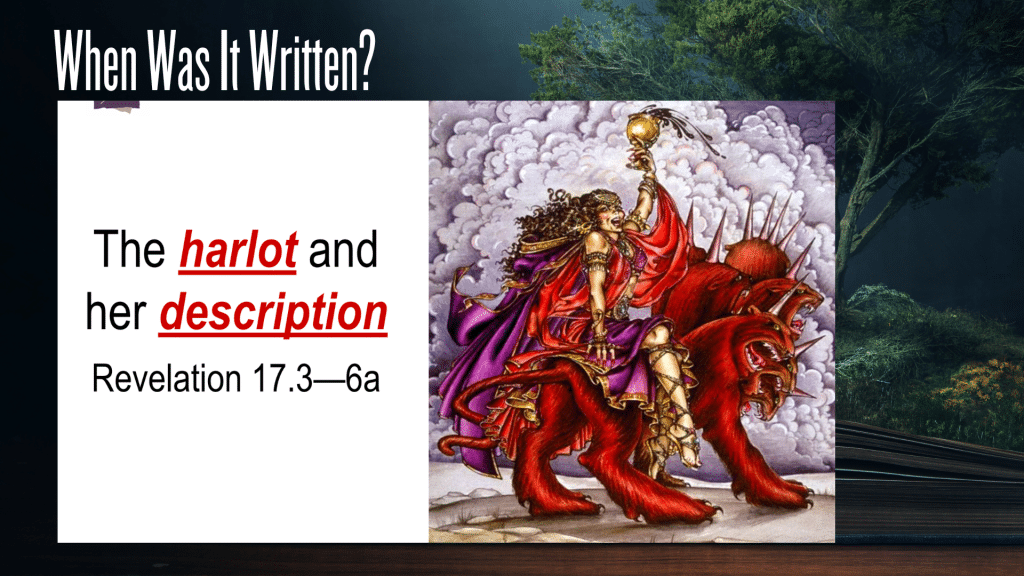
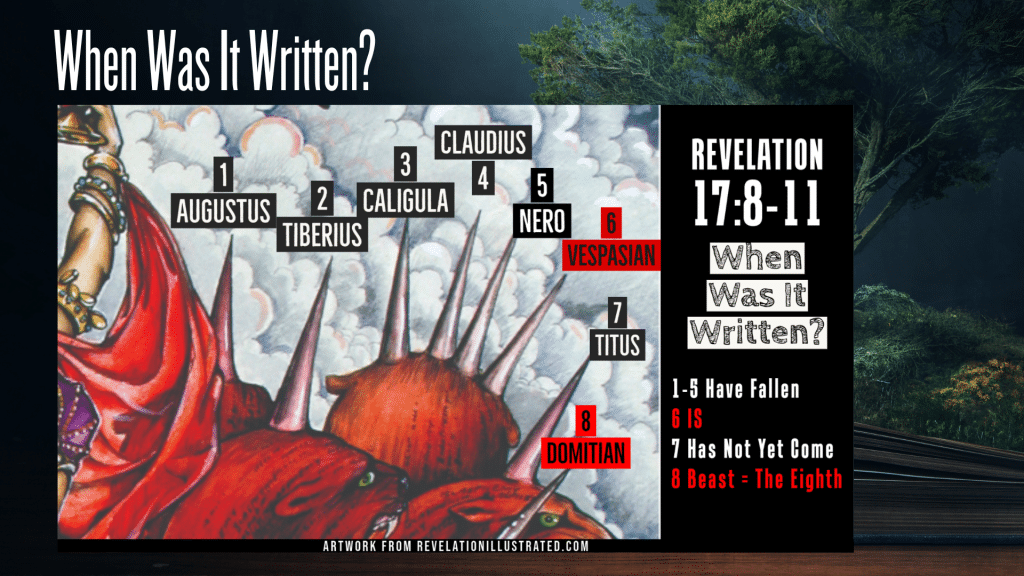
Revelation 17 (Lesson 3) – Aaron Cozort – August 9, 2026

In Admonition Podcast, Bible Study, Christian theology, Christian Victory, Daniel, end times, Jesus Christ, keywords Revelation, Kingdom of God, prophecy, Roman Empire by Aaron Cozort

image

Good to see everyone here this morning.

I jinxed myself on the way here.

I made a comment to my mother in law that it’s a good thing she came for an extended visit

this particular year because this very well may be the smoothest ride you ever get on an

interstate in Memphis right now.

And I said that and not uh not five minutes later we get to the three eighty five exit to

get off two forty and come down three eighty five as completely blocked off.

And

They they didn’t bother to tell any of you know Google or Apple or anybody else that

they’re shutting down the uh the the entrance onto three eighty five.

Nothing.

Nothing.

No indication at all that hey by the way, three eighty five’s closed.

So it takes a little longer to get here on Poplar.

I’ll just tell I’ll just tell you that.

All right.

So it we’re we’re we’re just glad to be here and uh glad all of you are here and we can be

grateful for safety and smooth roads that we can’t eventually drive on.

So all right, let’s begin with a word of prayer and then we’ll get into our study.

Gracious Father in heaven, we come before you grateful for the day that you’ve blessed us

with, for the beauty of it, for all that you do for us.

And all that you have granted to us for the beauty of the world and the earth, the

provisions that you grant to us, the sunshine, the rain, all of the things that are upheld

by the word of your power.

Lord, we pray that you will be with us as we go through this day.

May the things that we say and the things that we do be right and in accordance with your

will, and in and may we help uh others and encourage one another to

Know what your word has in it that we might know how you would have us to live and how you

would have us to serve you.

All this we pray and ask in Jesus’ name.

Amen.

So a little bit of level setting because we’re we’re nearing the end of chapter 17.

So by way of review, going back through what we’ve discussed in the book of Revelation.

Chapter one, the book opens in John.

Is there on the Isle of Patmos?

It is the Lord’s Day.

He is in the Spirit on the Lord’s Day, as the text says.

And interesting point, one worth continuing to bring up.

John states at the opening of the book, because so many people will in the religious world

will come to this book and they say, This is about when Christ returns to establish his

kingdom.

That’s what they’re gonna tell you it’s about.

That’s what uh all the Jehovah’s Witness doctrine tells you the book of Revelation is

about.

Th these are the signs and this is what’s gonna happen at the coming of the kingdom.

John writes in Revelation chapter 1, verse 9, that he is our brother in the kingdom.

Present tense.

He says, I am your brother in tribulation.

I’m going to go through this with you, and you and I are in the kingdom.

Jesus would say in Mark chapter 9, verse 1, as he spoke to his apostles.

He said, Some of you standing here shall not taste death till you see the kingdom of God

present or come with power.

And there’s one of those apostles who was not alive when that happened.

Which one?

Judas.

The other eleven were present on the day of Pentecost in Jerusalem when the kingdom of God

came with power.

Whose power was it that it came with?

The power of the Holy Spirit.

It came as a direct fulfillment of what Joel prophesied in Joel chapter two, and Peter

said this is that which Joel prophesied.

So the kingdom came.

The kingdom is already here.

It came with power.

And John was in the kingdom when he wrote the book of Revelation, which tells us the book

of Revelation is not about the coming of the kingdom.

It is about the fulfilling of the prophecies concerning the kingdom that Daniel saw and

interpreted, and the fulfillment of what God promised to do in the kingdom in that he

would establish a kingdom that would never be destroyed.

And John is writing to the church, which makes up the kingdom of God on earth, and he is

writing to those Christians to tell them, I know it looks like the kingdom’s gonna fall.

I know it looks like the beast is gonna win.

I know it looks like the devil’s got a hold on you, and you are going to be crushed by the

Roman Emperor and his.

minions and I know it looks like everything that God said from A D six hundred all the way

forward is going to fail.

But I’m writing this book to let you know you win.

And it won’t look like it midway through.

But I’m going to tell you how it turns out.

So John is in the Spirit on the Lord’s Day on the Isle of Patmos as he begins to write the

vision and the things which he saw.

And he turns to hear a voice that spoke behind him, and he fell on the ground because of

the presence of the one whose presence was there speaking to him, and it looked like

Christ, but in a glorified state.

And Christ was standing there holding in his right hand the seven stars, which represent

the seven churches, and was surrounded by the seven golden lampstands, which represent the

messengers of the seven churches.

And John is told to write to the seven churches of Asia Minor because they’re going to go

through this because they’re Roman cities.

And he writes to them to tell them, I know your works.

I know what you’ve done.

I know what you’re good at, and I know what you’re bad at.

I know that some of you I’m putting no more burden on because you’re already going through

it.

And some of you, you repent, or I’m going to come make war with you.

Chapter 4 opens, and John sees an open door in heaven and is basically called to go

through the door.

He goes through the door and he enters into the throne room of God and he sees the one

who’s sitting on the throne.

And he doesn’t describe the one who’s sitting on the throne.

He describes the glory of the one who’s sitting on the throne, and the glory that

surrounds the throne, and the sea of glass that surrounds the throne, and the four beasts

that surround the throne, and the twenty-four elders that surround the throne.

And their singular message is this: the one who’s on the throne.

Reigns and is worthy.

Interestingly, if you had a throne and you had a person on the throne, and the person on

the throne was reigning, what might you call the person who’s on the throne?

A king.

What is a king if he’s reigning?

What does he have?

Power and a kingdom.

When John walks through the door to the throne room of God, he sees a king who is reigning

over his kingdom.

And then you find that not only is there a king reigning over his kingdom, but there’s

twenty four elders that are sitting on

What does John call the things they’re sitting on?

Front.

they come off those thrones and they take the crowns that they wear and they cast them

before the one who they sit before because they’re praising the one who’s sitting on the

throne, who is a king, who has a kingdom.

And they worship him.

And then as chapter six or chapter five opens, rather, the one who’s sitting on the throne

has a scroll in his right hand.

And John is desiring to see what is in the scroll, to know what is written on the scroll,

because it’s written on the inside and then on the out, and it’s sealed with seven seals.

And they go through heaven and earth to find someone who’s worthy to open the scroll and

to read the message from the king who.

Who’s sitting on the throne?

And no one can be found.

John begins to weep, but one of the angels comes to tell John, don’t weep, for we found

the one who’s worthy to open the scroll.

And it’s the Lamb who was slain and who is alive.

It’s the lion of the tribe of Judah.

It’s the Christ.

And so the one who is the lion, who is the lamb.

who is the Christ goes and takes the scroll from the one who’s sitting on the throne.

And he opens the scroll.

And before he opens the scroll, as he is worthy to take the scroll, he is declared worthy

to be the one who is king.

And the Hebrew writer helps us with this, by the way.

Because the Hebrew writer tells us that all things were put under his feet.

That is Christ.

But the Hebrew writer makes it incredibly clear.

He says when we say all things were put under his feet, Christ, that of course excludes

the one who put all things under his feet, which is who?

God the Father.

Uh it’s this interesting thing about universal affirmatives.

All things well, technically the Hebrew writer says, well, it’s some things.

Because there’s one thing that is excluded from everything, and it’s God the Father is not

put under the feet of Christ.

Yes, sir.

Mm-hmm.

they controlled what would have been considered the known world at that time, in the sense

that yeah uh they didn’t control China, they didn’t control other parts of the region.

So, from a regional perspective, for a person in the Roman Empire, they they were the

world power.

But uh there were regions of the planet that that those people

had never traveled to and and would not have been cons they would have considered those to

be the the barbarian regions.

Yeah.

So so from from that perspective, the perspective of a first century person in that Middle

East region, they can they controlled the whole known world.

Good question.

um So when you when you look at chapter six

Chapter six, or sorry, chapter five, get my numbers right.

Chapter five says there’s one who’s sitting on the throne.

And there’s one who’s before the throne, who’s the lamb, who has all the same power and

all the same might and all the same worthiness as the one who sits on the throne.

He doesn’t supplant the one who sits on the throne.

He shares his glory.

Okay?

And you remember in John chapter 17, Jesus prayed to the Father that when he was about to

go to the cross, that God would restore to him the glory that he had with the Father

before the world was.

So Jesus says, I’m going back to my rightful position, sharing the glory of deity at the

throne.

Okay.

So if you have a lamb who’s worthy to reign, who shares the glory of God the Father who’s

sitting on the throne, then you might consider that the one who’s reigning, who is the

Lamb, has is a king who has a kingdom, and he is reigning over his kingdom.

And John’s point is, we’re supposed to know all of this already, because Daniel prophesied

that it was going to happen in the days of these kings, that the God of heaven was going

to set up a kingdom which would never be destroyed.

And for all the Jehovah’s Witnesses and for all those in the religious world who are of a

dispensational premillennialist mindset that say they’re still waiting for the kingdom.

You disagree with Daniel.

Because Daniel said it was going to happen in the days of the Roman Empire.

That these things would happen and the God of heaven would set up a kingdom.

So either you’re right or Daniel’s right, but you can’t both be right.

So chapter six opens, and the one who is worthy to sit on the throne, the one who is the

lamb who was slain, the lion of the tribe of Judah, Jesus Christ, begins to open the

scroll and begins to loose the seals, and he sees first the white horse, then the red

horse, then the black horse, then the pale horse.

And it begins, and it looks like the church is winning.

It looks like the kingdom of God is going forth and conquering all the other nations

because that’s what J Nebuchadnezzar saw in the vision.

He saw this mountain rise up, made without hands, and the mountain turned into a great

kingdom, and it wiped away all the other kingdoms.

The white horse goes forth and he’s conquering, and it looks like nobody’s gonna stop him

except then the red horse comes and and war begins, and the black horse comes and economic

pressures begin, and the pale horse comes, and who’s sitting on the pale horse?

If you know the Johnny Cash song, you know.

Death is sitting on the pale horse and hell follows with him.

And it looks like the kingdom is going to be decimated by the powers of Satan.

And then the fifth seal is open, and under the altar are the souls of the saints who have

been dying for the testimony of Jesus Christ and for his word, and they are crying out to

the Lord, how long are you going to let this happen?

How long, O Lord, faithful and true?

We’re not doubting your ability and we’re not doubting your faithfulness and we’re not

doubting your authority and we’re not doubting your power.

We’re just wondering how long until we see it.

Because we’re dead, and a whole lot of those who we know and love who are faithful to you

are going to die too.

And they’re given robes and they’re told to rest for a little while.

And the sixth seal is open, and God’s answer is forecasted.

Yeah, I’m going to deal with these people.

And when I’m close to being done, they’re going to go and call for the mountains to fall

on them to protect them from the wrath of the Lamb.

But before we do that, chapter 8 or chapter 7 opens, and God says, Hold on, before we

start this judgment thing, we need to mark those that belong to God because I’m not

judging them.

And so the angels go and they they mark all those who belong to the Lamb and who have the

testimony of his name.

And chapter 3 tells us, as John writes to the churches, that the churches are those who

wear the name of God.

So those who are in the kingdom and those who belong to God and are those who have his

name written on their forehead, and it’s the Christians in the churches that are being

persecuted by Rome.

And so you have seven angels.

After all those who belong to God are marked, you have seven angels, and they are given

seven trumpets, and they begin to pronounce partial judgment that goes out to the

persecutors of God’s kingdom.

God’s church.

And they begin to blow those trumpets, and with each trumpet comes uh a picture like an

Exodus plague.

But it’s all partial judgment.

A fourth of this dies, and a fourth of this is destroyed, and a fourth of this, and a

fourth of that.

And as these trumpets progress.

More judgments, more warnings come from God to those persecuting powers saying you can

repent, you’ve still got time.

Then the seventh trumpet blows, and inside the seventh trumpet, you have a warning as

those last three trumpets blow that there’s there’s more coming.

Repent now.

And then there’s a pause.

And John sees a mighty angel with one foot on the land and one foot on the sea.

God reigns over land and sea, right?

And his messenger can come put his feet down on land and sea because that’s part of God’s

kingdom.

And he’s got another message in his hand.

And John is told to go take the little book and to read the message.

And he says, it’s going to be sweet in your mouth and it’s going to be bitter in your

belly.

Because the message is going to be the Christians win, but they win through the

tribulation.

They win through the hardship that’s coming.

They’re victorious, but they’re going to go through it.

And so John sees two witnesses.

He sees the olive trees standing there.

And these witnesses declare the word of God, and they have the lampstands, and their light

never goes out.

And he sees the two witnesses in human form, and they look like Moses and Elijah in the

works that they perform.

This is the Old Testament prophet’s testimony that you’re going to speak the word of God,

you’re going to be faithful to the word of God, and the world is not going to hear you.

Rather, they’re going to kill you.

But as John watches the vision and he sees these things occur, he sees the testimony for

the Word of God proclaimed by the two witnesses.

And as long as they’re speaking the Word of God, the world can’t touch them.

That the moment the message is finished, the world kills them and leaves their bet their

bodies dead lying in the street.

For three and a half days, they don’t even bury them.

They just throw a party and rejoice that the people who were speaking the word of God are

dead.

But three and a half days later, half of a seven, there’s a lot of sevens, there’s a lot

of three and a halves in the book.

For a partial amount of time, it looks like the world wins.

But God says, Hold on, wait a minute.

He resurrects his witnesses back to life, brings them up into heaven, and judgment

commences.

Another picture saying, No, world, you don’t win.

But my people are going to be faithful to me.

You’re going to kill them.

You’re going to persecute them.

And then I’m going to judge you.

And then chapter 12 opens.

And John sees a woman.

And she looks like the church.

She looks like the people of God.

She looks like Israel of old that brought forth the Messiah.

And she brings forth a child and the devil, the dragon.

This red serpent is there and he’s waiting to consume the child.

He’s waiting to kill the Messiah.

He thinks, you know what, if I can just kill this baby, I win.

And just as he thinks he’s about to consume the child, God brings the child up in heaven.

So you see Satan and his minions follow him up into heaven and go make war with the

angels.

Now, are we being told about a literal physical event where the where Satan left the earth

with his minions and they went up into heaven and they made war, and Michael the archangel

sends them back down?

No.

The point is the devil loses to Christ on earth.

He loses to Christ in heaven.

And he even loses to the descendants of God’s people on earth.

The devil loses everywhere he goes.

But the dragon brings forth the sea beast and land beast.

And remember where the mighty angel put his feet?

He put his feet in the kingdom of God.

He put his feet where God has authority and God has power.

God rules over the kingdoms of men.

Isn’t that what God told Nebuchadnezzar?

Da way back in Daniel chapter four, when Nebuchadnezzar got to go eat grass like a cow,

and got to have his hair grow out like birds’ wings, birds’ feathers, a and got to spend

all that time not ruling over his kingdom that he thought he built.

And then God not only brought his right mind back to him, but put him back on the throne

that God had reserved for Nebuchadnezzar while all of this was transpiring?

Now you pause for a moment and think.

Do you not think that there was someone in the Babylonian kingdom that was ambitious, that

was power hungry, that would have in a moment usurped Nebuchadnezzar’s position on the

throne and taken the throne?

I’m not aware of many courts or kingdoms where there’s not somebody of that personality

and of that demeanor ready to take the throne at any moments of weakness.

And God makes it so clear that he rules in the kingdoms of men and gives it to whomever he

wills, that not a single one of those people was able to take the throne from

Nebuchadnezzar while Nebuchadnezzar was out grazing like a cow.

Mean how more vulnerable can you get?

What happens to cows?

huh.

Ground beef.

They get slaughtered.

And God makes it clear in Nebuchadnezzar.

I can put you in such a vulnerable position that you could be slaughtered tomorrow if you

were the cow that you’re acting like.

And I can take you out there and I can make you graze like a cow, and then I can put you

right back on that throne, and I can make sure nobody touches your throne while you’re

gone.

From which Nebuchadnezzar writes, The kingdom of God, or God rules in the kingdoms of men.

So when the angel comes down and sets his feet on the right on the land and on the sea,

and hands John a little book and says, Hey, this is how it’s going to work out, he’s

declaring God rules.

And his messengers can put their feet wherever they want to.

But then out of the land and out of the sea, the dragon brings forth his minions, his

kingdom, his

Roman armies and his false prophets and his false teachers and those who say if you want

to sell in the marketplace of Rome here in Ephesus, you’re going to have to declare that

Caesar is God.

Watch the thing from World Video Bible School.

They recently posted John Moore in his uh Bible Lands passages was discussing Ephesus.

And there at the gate of

To the marketplace, there was an image made to Domitian.

An image made to the Caesar, who’s going to be the one persecuting the church and

declaring him to reign as the son of God.

And so as you walked into that marketplace at the end of the first century and the

beginning of the second century, that same marketplace most likely that Paul would have

sat at with Aquila and Priscilla and made tents and sold them, that same marketplace you

would have walked under a gateway to an image, to a Caesar, declared to be the Son of God.

And so the beast rises up and the beast is Rome, inhib in exhibiting the power of Satan to

destroy the kingdom, and the beast has his minions and it’s the land beast and the sea

beast, and they’re going forth and they’re declaring, Listen, if you don’t worship Caesar,

if you don’t worship Rome, you’re going to die.

Then chapter 14 opens up, and where do you see the saints?

Well, you see them dead and and slaughtered and lying all over.

No, you don’t.

You see them standing on Mount Zion with the lamb, rejoicing and singing because they’re

victorious.

They’re not dead.

They didn’t lose.

They weren’t vanquished.

They weren’t destroyed.

They win.

In chapter 14, you see the 144,000, an exemplification of God’s people.

You see a declaration in chapter 14: Babylon is fallen, that great city.

Hey, you know, look back in history.

Where’s Babylon?

It’s gone.

Guess what?

God said it would be.

Look at the new Babylon, Rome.

Where is it gonna be?

The same place the old one was, fallen.

Gone.

And there’s one who’s given a sharp sickle.

And he’s sitting on a cloud and he’s told, go reap the earth.

Go harvest the field that I’ve made ready.

And so the bowls begin to be poured out.

The judgments begin to commence.

God says, You didn’t repent, you didn’t follow my warning.

Now here comes final judgment.

And so in chapter 15 and 16, seven angels are handed seven bowls, and they proceed to pour

out the judgments of God.

And again,

These Egyptian plagues, like we saw in Exodus, are again rehearsed, and now it’s a full

judgment, not a partial judgment.

So, chapter 17, after these bowls are all poured out, John says, Hold on, uh we need to go

look deeper at who this beast is, who this dragon is, and the woman who rides on him that

looks like a harlot, because she is, because she seduced all the kingdoms of the earth.

to make war against God and to rebel against God and to worship Caesar instead.

And so John begins to describe the harlot as he sees in the vision.

And he she looks like she’s the one who’s in charge.

She looks like she has the power of all the kings of the earth.

She looks like she’s riding on Satan and she’s conquering.

But she’s drinking.

She’s drinking from the blood of the saints who she’s persecuting.

And God says, I’m going to show you how she falls.

But he identifies in chapter seventeen the one

Or the time where all this is going to occur, and the beginning of this judgment.

And as we discussed last week, it happens during the time of the seven heads that are

seven mountains, verse nine, which the woman sits.

There are seven kings, five have fallen, one is, and the other is not yet come, and when

he comes, he must continue for a short time.

The beast that was and is not is himself also the eighth.

and is of the seven and is going into perdition.

And so we looked last week at the kings of Rome, beginning with Augustus, and how they

match exactly what John is saying, and John is using the picture from Daniel seven, and

Daniel and John are right there in agreement.

The book is received during the days where the persecution has not yet begun, in the days

of the sixth king, which is Vespasian.

It is towards the end of his time on the throne, because there’s another king coming who’s

going to be the seventh, and he’s going to be there for a little while, and Titus will

come to the throne, the son of Vespasian, and he will reign for two years, two months, and

two days.

And then Domitian will come to the throne and he will be the eighth.

And he will come to the throne and he will make it governmental policy across the Roman

Empire to persecute Christians.

And persecution will commence that will continue for two hundred years.

But God says, don’t worry about it.

In the person of Domitian, I’m going to judge Rome and I’m going to declare her done.

Just the way I did in Nebuchadnezzar’s day.

And while it looks like you’re going to die, and it looks like you’re going to suffer, and

you are Christians, I’m going to tell you how it’s going to end.

I’m going to tell you how it’s going to turn out.

So we notice verse 11.

The beast that was and is not is himself also the eight, and is of the seven and is going

into perdition.

The ten kings which you saw, sorry, the ten horns which you saw are ten kings who have

received no kingdom as yet, but they receive authority for one hour as kings with the

beast.

That there’s there’s subjugated kings, the kings in the regions around Rome that they

would gain authority over.

And they would draw tribute from, and they would draw authority from, and they would

expand the power of Rome from the willingness of those kings to cooperate, would also

become the kings that would rebel against Rome and would ultimately lead to part of the

downfall of Rome.

Yes, sir.

Domitian.

The three that are taken out are Otho, Galba and Vitilius, and they come and go in two

years during a period of civil war in in Rome.

Correct, because uh Rome is in in the days that Nero falls, so Nero dies, and because Nero

had so corrupted the Senate and everything about the government in Rome, which is why he

was killing Christians, is it was an excuse to of not have people look at what he was

doing to the government, the the government is just in complete disarray.

So th s one faction will put Otho up as emperor.

And another faction will begin a civil war and overthrow Otho and kill him.

And so Galba’s put up as emperor by another faction and then they’ll kill him.

And another em the third emperor comes up and they kill him, right?

So uh in two years of just complete disarray in Rome are is the the three that Daniel

describes as being the ones who are uprooted.

Okay?

Yes, you even when you read Tertullian and and others, there were historians of the first

century in ancient times, they all wrote that Nero basic or sorry, Domitian was like

having a second Nero.

He he carried on and and by the way, you can see this idea in the Old Testament in the

kings of the northern kingdom of Israel, where God will say, This king did evil.

Like Jeroboam.

Right?

They’ll go back and the good kings, this one was faithful like David.

There’s set been seven kings between this one and David, but this one was faithful like

David.

And so what John is saying here is with the eighth, with Domitian, you’re going to look

back and you’re going to see him in the past.

And you’re going to see him in Nero.

You’re going to see him in number five.

Okay?

You’re going to see him, he’s in the seven that have already come and gone.

So you’re seeing this little Nero.

Not that they were by related by blood or relationship, family relationship, but that

their rule and their authority and their declaring themselves to be God is what is seen in

that.

Okay?

So, verse all good questions, and feel free to ask any questions as we go along.

He says, verse 13, these are of one mind.

And they will give their power and authority to the beast.

Notice these ten subjugated kings, they’re feeding the beast their authority and their

power.

They’re handing their power and authority over the beast, saying, Hey, do whatever you

want to.

Okay?

He says, These will make war with the lamb, and the lamb will overcome them.

For he is Lord of lords and king of kings, and those who are with him are called.

Chosen and faithful.

God says, I’m gonna tell you what’s gonna happen.

As Rome’s power coalesces around the throne and around Caesar, he’s going to start

employing his authorities around his empire to start persecuting Christians.

And they’re going to start killing them.

And they’re going to start persecuting them.

And when they do, I’m going to tell you how it’s going turn out.

They’re going to lose.

Because the Lamb.

Is going to make war with them.

And you won’t be able to open the books of history and go, look, in this province, the

Christians overthrew the government and took that king out.

No, that’s not how the Christians win.

How do the Christians win?

Well, you go look back in the text, and what does he say about those who are with the

Lamb?

They are called, chosen, and faithful.

The Christians don’t win by overthrowing the government.

Special note to those in America today.

The Christians don’t win by overthrowing the government.

They win by preaching the gospel.

They win by changing the hearts and minds of men.

It was in Paul’s day that they would accuse Paul of being one who had turned the world

upside down with the message of Jesus Christ.

And yet amazingly, Paul never raised an army.

Paul never went to war against Rome.

Paul is likely going to die at the very hand of Nero.

And yet Paul is said to have turned the world upside down with the message of the cross.

Revelation 17 says we win.

And we didn’t win by starting a rebellion or starting a war or taking up arms in the

physical sense.

We win by being called, chosen, and faithful.

And chapter 17, verse 15, then he said to me, The waters which you saw, where the harlot

sits, are peoples, multitudes, nations, and tongues.

Now what do we do when we get in the text and the text tells us what something is?

We know that’s what it is.

So what are the waters that the woman sits on?

There it is, peoples, multitudes, nations, and tongues.

This is a government.

Big surprise, isn’t it?

Because that’s the thing that sits over peoples and multitudes, nations and tongues.

A government.

And so he says, here’s the woman.

And the waters that you saw underneath her.

Are the upon which the harlot sits are peoples, multitudes, nations, and tongues.

And the ten horns which you saw on the beast, these will hate the harlot.

Now, just a moment ago, we read that the kings that were the horns are giving their power

and authority to the harlot, right?

So John tells you they’re not doing it because they like her, they’re doing it while they

hate her.

He says these ten horns which you saw on the beast, these will hate the harlot, make her

desolate and naked, eat her flesh, and burn her with fire.

For those who have read the history of Rome, did Rome fall from the inside or the outside?

The inside.

God says, I’m gonna win.

And I’m going to defeat the harlot.

And I’m going to defeat her minions.

And I’m going to do it by turning them against themselves.

Because where she thinks her power comes from are a group of people that hate her.

And he goes on to write For God has put it in their hearts to fulfill his purpose.

To be of one mind and to give their kingdom to the beast until the words of God are

fulfilled.

And the woman whom you saw is.

That great city which reigns over the kings of the earth.

When you open the book of Revelation.

And John tells you what something is, that’s what it is.

And in chapter 17, John says that the woman, the harlot, that rides on the dragon, that

has seven heads and ten horns and an eighth head that comes up, and the horns are ten

kings that give their power and authority to the harlot, and the horns are the ones who

are going to rebel and burn her and destroy her from the inside out.

That woman, in the present tense, is the city that rules over the kingdoms of the earth.

Now, when John was sitting on the Isle of Patmos in the first century in exile for the

testimony of Jesus Christ and his kingdom, and was writing that he was in the kingdom of

Jesus Christ as he was writing this, and that Christ was on the throne, and that God the

Father was on the throne, and that yet there was a kingdom and a harlot that was ruling

over the kings of the earth.

What

city at that moment in time was ruling over the kingdoms of the earth.

It’s really not hard, folks.

If you let the text speak for itself.

The book was written when that persecuting king hadn’t yet come up.

It was written in the lull between one persecutor and another.

And it was written about a city, about a kingdom that thought it was going to defeat the

one who sat on the real throne in heaven.

And the one who sits on the real throne in heaven says, Oh no, you’re not.

And I’m going to tell you how you’re going to fall.

And I’m going to tell you how I’m going to destroy you.

And then I’m going to say, everything I wrote in Old Testament prophecy has been

fulfilled.

You see, chapter 17 is the clear declaration that this book is the reassurance that what

God wrote and showed Daniel in a vision in Daniel chapter 7, in Daniel chapter 12, in

Daniel chapter 2, he was going to fulfill every single aspect.

And he wasn’t going to miss a single point.

And God says, I’ll tell you when the woman’s gonna fall.

When everything that I said I’d do is done.

And when she falls, everything I said I’d do will be done.

Okay?

Thank you for your attention.

Worship (Background and Fundamentals) (Lesson 3) – Aaron Cozort – August 05, 2026

In acceptable worship, Acts, Admonition Podcast, Biblical Principles, faith, Genesis, Isaiah, keywords Worship, Obedience, relationship with God, Spiritual journey by Aaron Cozort

image

Good evening.

Hmm.

It’s good to see everyone this evening.

We’re continuing our study of worship and so I encourage you if you will to uh take your

Bibles and open them to the book of Genesis.

We’ve been considering the background concepts of worship, initially examining the idea

that worship is as old as creation, and noticing that in the form of the way that the

Bible speaks concerning the creation glorying or glorifying God.

And that idea of a generic sense of worship, it brings honor and glory to him because he

created it and it serves its purpose.

It does exactly what he created it to do.

So we’re going to pick up from there this evening, but let’s begin with a word of prayer

in our and we’ll get into our class.

Our gracious God, one who is worthy of praise, worthy of glory.

We come this evening bringing together our hearts and our minds to study your word, to

learn more about you, that we might come to a full knowledge of what you would have us to

do and how you would have us to live.

And Lord, we seek daily to bring that honor and that glory to your name in our lives, in

our actions, in our choices.

We know sometimes we fall short of your glory.

And we fail to do what you’ve commanded us to do, or we’ve failed to keep your

commandments.

And Lord, we pray that you will forgive us of those things when we do wrong.

Lord, we are mindful of those who are struggling because of ailments, illnesses,

difficulties.

And we pray that you will give them strength.

Pray that you will give them the health that they desire to have.

We pray for those with upcoming procedures and with

uh procedures that have occurred, we pray that you give them the desired health as well

that they uh would long for.

Lord, we pray for those who have lost loved ones and pray that you give them comfort and

strength.

Lord, we are mindful of our local elections that are coming and just uh tomorrow, and we

pray that your will be done in these matters, but we also pray that people

Have a mindset to look to your word to decide both how to conform their lives to it, but

also how to build a nation that is continually continually looking to your word for

guidance and for strength.

Lord, we pray that you will be with us as we go through this period of study.

May the things that we learn be things that we can apply to our hearts and our minds and

our daily lives.

Lord, will you forgive us when we sin and fall short of your glory?

All this we pray in Jesus’ name.

Amen.

In Genesis chapter four

We read in chapter four verse one, Now Adam knew Eve, his wife, and she conceived and bore

Cain, and said, I have acquired a man from the Lord.

Then she bore again this time his brother Abel.

Now Abel was a keeper of sheep, but Cain a tiller of the ground.

And in the process of time it came to pass that Cain brought an offering of the fruit of

the ground to the Lord.

Abel also brought of the offer uh of the firstborn of the flock and of their fat, and the

Lord respected Abel and his offering.

But he did not respect Cain and his offering, and Cain was very angry and his countenance

fell.

So the Lord said to Cain, Why are you angry?

And why is your countenance fallen?

If you do well, will you not be accepted?

Want to spend just a moment with this phrase that we find here in verse 7.

Because God, as he presents this situation to Cain, there’s no indication in the text that

God spoke to Abel about this.

uh Rather, that God spoke to Cain, Cain went out and killed Abel.

But as God presents this to Cain, because Cain is angry that his offering is.

Not being accepted.

Now, bear in mind, we don’t know all the ins and outs of how did Cain know that, other

than the Lord addressing it with Cain.

What is it that was in the offering that was different?

What is it that was accepted versus unaccepted?

There’s a lot of things about this event that we do not understand.

But this we do understand.

The Lord specifically says to Cain, if you what?

Do well.

It is of interest and it is of note that the Lord did not say to Cain, if you feel like

you did well.

If you are of the opinion that you did well, was Cain already of the opinion that he did

well?

Yes, that’s why he’s angry and wroth because his sacrifice isn’t accepted.

Cain felt like he did well.

Cain felt like his sacrifice should have been accepted.

Cain was angry when it wasn’t accepted.

God’s point is: if you had done well, it would have been accepted.

And from the beginning of the discussion of worship, God sets a premise on this singular

fact.

God accepts the worship God prescribes.

And not the worship man decides.

Worship in Scripture is always prescriptive.

It is set by the Lord.

It is accepted in conditions with His terms.

It is either in accordance with His commandments or it is not.

But from the beginning of the discussion of worship in the scripture all the way to the

end, all the way to the point in Revelation chapter 22, where John in the vision sees

himself fall down and worship an angel in the very last chapter of the book, and the angel

says, get up, you don’t get to decide who to worship.

You worship God.

From beginning of Genesis to the end of Revelation, God makes it clear he accepts the

worship he prescribes and he alone is worthy of that worship.

And so God addresses with Cain.

If you do well, will you not will your uh will you not be accepted?

And if you do not do well, sin lies at the door.

God, as he confronts Cain, points out that when it comes to worship, it’s up to the person

who is offering the worship to choose whether or not their worship will be accepted.

It’s not God being arbitrary.

And there’s no indication from the text whatsoever that God is being arbitrary with Cain.

That God has just allowed Cain and Abel to do whatever they so choose, and he will decide

on a whim whether or not to accept their worship, given that he gave them no instructions,

no information, no commandments, none of that.

He just decided to let them figure it out.

That’s not what the text tells us.

That’s not what the text indicates.

Turn over to Hebrews chapter eleven.

We spent just a few moments here two weeks ago.

We’re gonna just spend a a little bit of time here.

In Hebrews chapter eleven, as the Hebrew writer comments on the events that transpire.

We find in Hebrews chapter eleven, verse one, now faith is the substance of things hoped

for, the evidence of things not seen.

For by it the elders obtained a good testimony.

By faith we understand that the worlds were framed by the word of God, so that the things

which are seen were not made of things which are visible.

Question.

When the Hebrew writer says by faith we understand that the worlds were framed by the Word

of God,

Are we to suppose that the Hebrew writer is meaning we have looked at the stars and we

have looked at the sky and we have looked at the heavens and we’ve looked at the earth and

we’ve looked at creation and we’ve come to a general surmising that this is how it must

have been done?

Or is the Hebrew writer saying, God has revealed by inspired testimony that the worlds

were created by the word of God?

Which one?

The second one.

The Hebrew writer is by no means implying that faith is something that someone just

conjures up out of themselves.

His discussion of faith is that which is testified to by inspired revelations.

He says, By faith we understand that the worlds were framed by the word of God, so that

the things which are seen were not made of things which are visible.

By faith Abel offered to God a more excellent sacrifice than Cain, through which he

obtained witness that he was righteous, God testifying of his gifts, and through it he

being dead.

Still speaks.

The Hebrew writer draws forward that not only was Abel’s sacrifice accepted, but brings

home the point of the testimony of God concerning Abel’s sacrifice.

As God addresses this with Cain and says, This sacrifice was accepted because it was

right.

And this sacrifice was not accepted because it was wrong.

Now it’s up to you, Cain.

You can continue to offer a sacrifice that is wrong and it will continue to not be

accepted, or you can fix the problem.

But at all points in time the problem was Cain.

Because God had given instruction.

God had told uh Cain and Abel what was acceptable.

You say, Aaron, how do we know that?

Because you cannot obey by faith without revelation.

You cannot obey without testimony from God in some form or fashion.

Now it can be prophetic testimony from years gone by.

It can be a demonstration, as was the case in the book of Exodus, where God demonstrated

his existence and his power and his might through the plagues and demonstrated that Israel

was his people.

But without a demonstration of revelation, either verbal revelation or revelation through

the events that transpire or revelation through a miraculous event, you cannot come to

faith without testimony.

And the testimony originates with God.

The Hebrew writer says, By faith we understand that the worlds were framed by the Word of

God.

The Hebrew writer doesn’t say that because he was present when it happened.

He says that because the Holy Spirit documented it through Moses and said, This is exactly

how it happened.

When we first understand that we are responsible for whether or not our worship is

accepted or not, we then have to evaluate what makes worship acceptable.

And what makes it unacceptable?

Turn to Isaiah chapter one.

Izeah is going to write.

the nation of Israel he’s going to prophesy and his prophecies will be recorded.

Izea chapter one.

Beginning in verse four, we read, Alas, sinful nation, a people laden with iniquity, a

brood of evildoers, children who are corrupt.

You know, God’s got a whole list of compliments for these people, have you noticed?

Supposed to be about some foreign nation, right?

No.

This is about Israel.

He says they have forsaken the Lord, they have provoked to anger the Holy One of Israel,

they have turned away backward.

Now notice who is at fault according to these three statements.

The people of Israel are they, they, they.

They have chosen.

They made the decision.

They have forsaken the Lord.

They have provoked anger the Holy One of Israel.

They have turned away backwards.

Why should you be stricken again?

You will revolt more and more.

The whole head is sick, the whole heart faints, from the sole of the foot to the head to

even to the head, there is no soundness in it, but wounds and bruises and putrefying

sores.

They have not been closed or bound up or soothed with ointment, your country is desolate,

your cities are burned with fire, strangers devour your land in your presence, and it is

desolate, as overthrown by strangers.

So the daughter of Zion is left as a booth in a vineyard, as a hut in a garden of

cucumbers, as a besieged city.

Unless the Lord of hosts had left us a very small remnant.

We would have become like Sodom.

We would have been made like Gomorrah.

As Isaiah opens this prophecy, he immediately zeroes in on Israel.

And what Israel has done and will not repent from doing.

And Isaiah makes it clear that it is only by the nature of God’s own mercy.

That we, the nation of Israel, in Isaiah’s day, have not been wiped off the face of the

planet.

Have not been consumed as Sodom and Gomorrah were consumed in the book of Genesis.

He says, Hear the word of the Lord, you rulers of Sodom.

Give ear to the law of our God, you people of Gomorrah.

He points out this isn’t a problem at the top.

This isn’t just a problem with leadership.

This is a problem with the people, too.

He says, I want you to listen, you leaders, and I want you to listen, you t you people,

because it’s a problem with both of you.

You can’t stand over here and say, Well, they they they made us do it.

They told us to worship this way.

They told us to forsake the Lord, while the people come over here and say, Well, well.

Or sorry, the leaders come over here and say, Well, you know, we just did what the people

wanted.

You remember what Saul’s excuse was when he came back, bringing King Agag and all of the

riches and all of the bounty from from the Amalekites?

Well, the people wanted to offer sacrifices to your God.

Samuel.

Now, Isaiah says, Hear the word of the Lord, you rulers of Sodom, give ear to the law of

our God, you people of Gomorrah.

To what purpose is the multitude of your sacrifices to me?

says the Lord.

I have had enough of burnt offerings of rams and the fat of fed cattle.

I do not delight in the blood of bulls or of the lambs or of goats.

And you pause for a moment and go, wait, wait, wait, wait, wait, wait, wait, wait, wait,

wait.

Hold on.

Wasn’t it the Lord who from Mount Sinai delivered to Moses the very the very uh recipes,

as it were, of what the sacrifice was to contain?

The very cut of meat that was supposed to go into the sacrifice?

The very portion that belonged to the Lord and not to the priests?

The very specific part that could be saved and retained for the person who offered the

sacrifice or the person who brought the sacrifice to consume as their portion of the

worship?

Wasn’t it the Lord who did all of that?

The answer is yes.

So did the Lord just get tired of the sacrifices?

Very first thing we understand about worship when it comes to the prescriptive nature of

worship is that God demands more than the physical act.

He says, When you come to appear before me, verse 12, who has required this from your hand

to trample my courts?

Bring no more feudal sacrifices.

Incense is an abomination to me, the new moons, the Sabbaths, the calling of assemblies, I

cannot endure, iniquity and the sacred meeting.

God says, I have had enough of you persisting in your sin while trying to get access to my

grace.

and telling people that they can come worship me without repenting.

The very first principle of the prescription of worship is God demands everything, not

just a physical act.

God requires the heart.

Notice what he says your new moons, your appointed feasts, my soul hates.

They are a trouble to me.

I am weary of bearing them.

When you spread out your hands, I will hide my eyes from you.

Even though you make many prayers, I will not hear.

Your hands are full of blood.

So God doesn’t just reject them, just like with Cain, God says, here’s your opportunity.

Not just a rejection, but rather an opportunity to fix the situation.

He says, Wash yourselves, make yourselves clean, put away the evil of your eyes, or of

your doings from before my eyes.

Cease to do evil, learn to do good, seek justice, rebuke the oppressor, defend the

fatherless, plead for the widow.

Come now, let us reason together, says the Lord.

Though your sins are like scarlet, they shall be as white as snow.

Though they are red like crimson, they shall be as wool, if you are willing and obedient.

God makes it clear.

If your worship is going to be accepted, your relationship with God must first be right.

And all the worship offered by all the correct particulars without the relationship with

God being right means nothing.

God will reject it immediately.

When we

Look at wors.

We have first the instruction.

God commands us to worship.

It is not optional.

It is obligatory.

It was obligatory in Cain and Abel’s day.

It is obligatory today.

But it begins with more than just the act or the physical participation in worship?

It begins with a right relationship with God.

Now, interesting question.

Can a person who does not have a right relationship with God offer worship that is

viewed by God as good.

Pause for a moment before you answer that question.

Turn to Acts.

Chapter ten.

Acts chapter 10, verse 1.

There was a certain man in Caesarea called Cornelius, a centurion of what is called the

Italian regiment, a devout man and one who feared God with all his household, who gave

alms generously to the people and prayed to God always.

Pause for a moment and understand something.

Is this man lost or saved?

Lost.

Get to it in a minute.

Why is he lost or saved?

Well, the text will tell us why.

But the fact of the matter is, he is performing actions that are good because he honors

who God is.

While at the same time not yet being in a right relationship with God, we’re not going to

see this as an exclusive one time environment example.

We’re going to see it again in just a moment.

But I want us to set a level and a premise that there are those in the world who have come

to a knowledge of who God is in a uh

Conceptual way that honor him as God and are yet not saved.

But their worship is not rejected the same way that someone who knows who God is and have

rejected God in all points is rejected.

Okay?

So so I’m setting up a premise here that God establishes something that we should

understand.

Not because it is what he desires for the final point, but because he desires the person

to take the journey.

Okay?

So we’re watching a journey occur.

This man, Cornelius, is praying to God.

He is giving alms to the people.

He fears God.

He is a devout man.

All of these characteristics.

describe him as someone who we would describe as a morally good person.

Who lives and acts out of his fear of the God who he knows exists, though he is at this

moment in time ignorant of what that God expects from him.

Okay?

So notice the position he’s in.

He knows God exists, he honors him as God.

That knowledge of who God is and that honor controls his actions.

And his life, and yet he is ignorant of God’s commandments.

Okay?

Watch the text.

About the ninth hour of the day, he saw clearly in a vision an angel of God coming in and

saying to him, Cornelius.

And when he observed him, he was afraid and said, What is it, Lord?

So he said to him, Your prayers and your alms have come up for a memorial before God.

Now

Just a moment ago, we read in Isaiah, God told Israel, because of your sin, your

rebellion, your rejection, I’m not even hearing your prayers.

Right?

And yet here the one who speaks to Cornelius says your prayers.

Have been brought before God.

True or false.

God hears the prayers of sinners.

True and false.

All right?

All right.

Text specifically states, in a passage that I don’t have the I don’t have the verse

reference memorized.

I believe it’s one of the Jewish count Sanhedrin that speaks it, but somebody’ll have to

check me on it.

We know oh I know, it’s it’s dealing with a man who was born who was born blind, who’s

healed by Jesus.

We know that God does not hear sinners.

That’s the statement that the man makes in justification of standing before the council

when they say, Who is this man who healed you?

He said, I know not.

But I can tell you what he isn’t.

He’s not a sinner.

Because we know God doesn’t hear sinners.

Okay?

But the distinction that is made here is important.

Here is a man seeking God.

And while he is ignorant of God’s commandments, he is seeking God out of a sincere heart.

And that is what comes before God as is described in the text as a memorial.

It is important when we define the idea of hears prayers that we actually give some

definition to what we mean by it.

Does the mother who has the child pestering her down every aisle of the entire store hear

the child say, Mom, can we get one?

Can we get one?

Can we get one?

For everything they see that is made of chocolate, candy, or anything else?

Does the mother hear the pleas of the child?

Is the mother going to buy everything the child says?

Can we get one?

No.

Might the pleas move the mother to do something benevolent for the child?

Maybe, maybe.

But it may not involve every piece of candy they see that they like.

that yes, that’s that’s correct.

That’s the difference between the grandmother and the mother.

I’m guilty.

So it notice here, we understand this from a mother’s perspective.

Here’s the request, denied.

That’s God and Israel in Isaiah 1.

I’m not listening to you.

Denied, denied, denied, denied, denied.

You expect me to give you buy you candy?

You haven’t behaved yet today.

And then there’s the, you know what?

You have been incredibly good today.

You’ve been long suffering through the last 17 stores that I’ve dragged you through.

And here we are at Kroger.

I’m going to not buy you everything you see that you want, but I am going to get you

something that’s good for you.

Okay?

We understand this concept.

Now, notice what happens.

When he observed him, he was afraid and said, What is it, Lord?

So he said to him, Your prayers, your alms have come up for a memorial before God.

Now send men to Joppa and send for Simon, whose surname is Peter.

He is lodging with Simon a tanner, whose house is by the sea.

He will tell you what you must do.

And when the angel who spoke to him departed, Cornelius called two of his household

servants and a devout soldier from among those who waited on him continually.

So when he explained all things to them, he sent them to Joppa.

Here is the life of a man who motivates his decisions based upon his belief and his

devotion in who God is.

And so when the angel says, go do this, his immediate reaction, just like Abraham of old,

is to go do exactly what he was told.

But notice further, verse 34.

After they the two men go to Joppa, after they retrieve Peter, after Peter and six men who

are Jews come to the house of this Gentile.

We read in verse 34: then Peter opened his mouth and said, In truth I perceive that God is

shows no partiality, but in every nation

Whoever fears him and works righteousness is accepted by him.

Now that fears him and does righteousness.

Means here is a person who is motivated by their knowledge of who God is.

And when God tells them to do something, they do it.

That’s the description.

And Peter says, I have come to understand through the course of the vision that you read

about there.

in the text that it doesn’t matter which nation you come from.

If you fear God and do what he says, you’re going to be accepted by him.

So notice

He says verse thirty six, the word which God sent to the children of Israel, preaching

peace through Jesus Christ, he is Lord of all, that word you know which was proclaimed

throughout all Judea and began from Galilee after the baptism which John preached, how God

anointed Jesus of Nazareth with the Holy Saint uh the Holy Spirit and with power, who went

about doing good and healing all who were oppressed by the devil, for God was with him.

And we are witnesses of all things which he did both in the land of the Jews and in

Jerusalem, whom they killed by hanging on a tree.

Him God raised up on the third day and showed him openly, not to all the people, but to

witnesses chosen before by God, even to us who ate and drank with him after he arose from

the dead.

And he commanded us to preach to the people.

And to testify that it is he who was ordained by God to be judge of the living and the

dead, to him all the prophets witness that through his name whoever believes in him will

receive the remission of sins.

Now Peter

Has just begun to speak, to explain to Cornelius and his entire household and all those

who are present who are gathered there to listen that God has been doing something in the

nation of Israel.

But that the results of what God was doing in Israel were intended and commanded to go to

the entire world.

But Peter makes it clear.

That it is through the preaching of the name of Christ.

The authority of Christ.

The gospel of Christ.

That remission of sins comes.

Why would Peter say that to a man who was devout, who was moral, who was praying

continually to God?

Why would Peter discuss the remission of sins?

Because the people had sins that needed remission.

The angel did not tell Cornelius, go send for Peter from Joppa, because he preaches a good

sermon and you’ll enjoy it.

He said, He will tell you what must do.

And for some strange reason when Peter shows up, Peter immediately starts talking about

the remission of sins.

Almost like Peter knew their condition.

Almost like we finally come to a realization, wait a minute, doing good, believing in God,

praying to God isn’t enough.

It isn’t enough because God said there’s something more you must do.

But for the person who is doing those things already, it doesn’t mean that God doesn’t

honor what they’re doing.

It doesn’t mean that God doesn’t honor the fact that they’re seeking him.

But there’s a difference between honoring the someone seeking and saying you found me.

You know, in the game of hide and seek growing up, all the people who participated honored

the fact that the person was seeking.

How did they honor the fact that the person was seeking?

By hiding.

Right?

We’re we’re participating in the game.

Have you ever seen a game I’ve seen I’ve witch I’ve witnessed this.

We probably all have.

Where there was somebody seeking and the people hiding got so bored of hiding they quit

playing the game and didn’t tell the person who was seeking?

You watch it happen.

All the kids are at grandma and grandpa’s.

All the kids are playing hide and seek.

One person’s told to go count.

The others go hide.

Before the person comes and finds them, come to find out there’s food available inside the

house.

So all the kids who are hiding go in and get the food.

And the person outside seeking can’t find anybody.

Why?

Because they’re looking outside.

The kids are on the inside.

God honors.

And it is seen here the fact that someone knows he exists, fears him, and motivates their

life in accordance with that knowledge.

But that’s not the same as having the remission of sins.

It is rather a point at which someone should be seeking and open to hearing the gospel.

And so while Peter is still speaking these words, verse forty-four, the Holy Spirit fell

upon all those who heard the word, and those of the circumcision who believed were

astonished, as many as came with Peter, because the gift of the Holy Spirit had been

poured out on the Gentiles also.

By the way, this is not an indication they were saved.

This is not the point at which they were saved.

You remember just a moment ago, verse thirty-eight, God, verse thirty-eight, anointed

Jesus of Nazareth with the Holy Spirit and with power.

Peter’s already described the fact that God poured out the Spirit on Jesus.

And demonstrated that he was who God said he was.

You’re going to go over to chapter 11, and you’re going to read where Peter is going to

describe the events that occur here to those back in Jerusalem, and he will describe it in

these words.

We saw the Spirit poured out on them just as on us at the beginning.

What he’s speaking of is Acts chapter 2 on the day of Pentecost, where the Spirit was

poured out on them and they spoke in tongues.

That wasn’t the point at which the people on the day of Pentecost were saved, and it

wasn’t the point at which the apostles were saved.

The pouring out of the Spirit, just as it occurs here, was a stamp of approval by God on

the situation.

God put his stamp of approval on Jesus at John the Baptist’s baptism of Jesus.

The Spirit descended like a dove, and God said, This is my beloved son.

God put his stamp of approval on the apostles when they began to preach on the day of

Pentecost, and the Spirit was poured out on them, and they spoke in tongues they had never

learned, never studied.

And God said, These are my spokesmen.

To every nation under heaven.

And God put his stamp of approval on the Gentiles being saved through the gospel.

When he caused the house of Cornelius to speak in tongues.

Now notice those of the circumcision were bel were astonished, who believed were

astonished, as many as came with Peter because the gift of the Holy Spirit had been poured

out on the Gentiles also, for they heard them speak with tongues and magnify God.

Then Peter answered.

Now pause for a moment and don’t let me just read right past that sentence.

What did the co the house of Cornelius do when the spirit was poured out on them?

The text says they magnified God.

What is that if we were to give a one word descriptive term to it that begins with a W and

is followed up by W O R.

They worshipped God.

Do you think God honored that?

Yes.

But it was honored in view of the obedience they were about to participate in.

Do you remember what God said to Israel?

Come now, let us reason together.

Go fix your hearts and your lives first.

Then come worship me.

The house of Cornelius had been doing that.

They had been fixing their hearts and their lives for quite some time.

God honored that.

Okay?

So bef since we’re not gonna have time to, you know, spend another hour and a half going

through these examples tonight, let me leave you with this so there’s no d confusion,

hopefully.

Can a person who is not a Christian, who has not been obedient to the gospel, offer

worship that is honoring of God?

Yes.

They can offer worship that honors God.

Can they be in a right relationship with God without being obedient to the gospel?

And the answer is no.

Can a Christian who has rejected God’s commandments in their lives and rebelled against

God in their lives offer worship that is honoring to God?

No, no matter how much they follow the prescription.

Because they do not first honor God.

Now there’s a long discussion about this in the book of Romans.

We’re gonna spend some time with it.

But I want us to have this appreciation for this reason.

And I won’t I’m I’m kind of trying to preface it and preload it, but I’m gonna give you

kind of the conclusion that we’re headed towards for a reason.

Matthew chapter five.

You all all already know the answer.

We’re just needing to apply it in the realm of worship.

Matthew chapter five verse thirteen, you are the salt of the earth, but if the salt loses

its flavor, how shall it be seasoned?

It is then good for nothing but to be thrown out and trampled underfoot by men.

You are the light of the world, a city that is set on a hill cannot be hidden, nor do they

light a lamp or p uh and put it under a basket, but on a lampstand and it gives light to

all who are in the house.

Let your light so shine before men that they may see your good works and what?

Now, whose father is being discussed here?

Yours.

Yours.

You’re the one in a right relationship with God.

But your life is to cause others to do what?

Toward God?

Glorify.

You see, when it works the way God built it to work, there will be those who are not yet

in a right relationship with God.

glorifying and worshiping God saying, I don’t know who this God is, and I don’t know

exactly everything that He’s told for me to do yet, but I know He’s God.

And that honors God.

And that is not only.

Recognized by God, it is exactly what God commands us to create in the world, is a world

that honors and glorifies God who they have not yet fully obeyed.

So when the opportunity comes for you for you to invite that friend who you know’s not a

Christian to come worship with you, don’t think, well, I mean I won’t do them any good

because they’re not a Christian.

yeah, well.

Because it provides them an opportunity to glorify the God who exists.

And that’s a good thing that hopefully leads them to be open to being obedient to the

commands of the God who exists.

Okay?

Thank you for your attention.

We’ll discuss this.

The Good Confession – Justin Evergarden – August 02, 2026

In Admonition Podcast, baptism, Bible Study, Christianity, faith, Jesus Christ, keywords Good Confession, Lordship, Salvation, Salvation Process by Aaron Cozort

image

If you would please turn your Bibles over to the book of First Timothy, chapter six, verse

twelve.

First Timothy six and verse twelve.

We frequently hear people refer to the phrase the good confession.

But what is the good confession?

What does it mean?

How does it affect us?

What does the Bible say about it?

These are all questions we seek to answer this evening.

So Paul begins in 1 Timothy 6, 1 through 12.

We read, starting in verse 11 and going through 16, but thou, O man of God,

Flee these things, and follow after righteousness, godliness, faith, love, patience,

meekness.

Fight the good fight of faith, laid hold on eternal life, whereunto thou art also called,

and hast professed a good profession before many witnesses.

I give thee charge in the sight of God who quickeneth all things, and before Christ Jesus,

who before Pontius Pilate witnessed a good confession.

That thou keep this commandment without spot, unrebukable, until the appearing of our Lord

Jesus Christ, which is in his times he shall show, who is the blessed and the only potent,

the king of kings, the Lord of Lords, who only hath immortality dwelling in the light

which no man can approach, unto whom no man hath seen nor can see, to whom be honor and

power everlasting.

Amen.

Paul tells Timothy to lay hold of eternal life.

Now that phrase lay hold is very important.

For the men in here, maybe you’ve wanted to lay hold on one of your enemies.

That is a phrase that denotes that we have to hold on tightly.

You are not letting them get away.

In this context, he is telling them that we need to grab hold of this.

The eternal life that’s being offered to us.

We must not let it go.

Because we have something special.

We have something worthwhile, something precious.

We have something, most of all, very much amazing.

And if we do that, we can have a relationship with our Creator.

We can have salvation through Jesus Christ, which ultimately leads us to a home in heaven.

We can have fellowship with the body of Christ.

And we should never let these things go.

So he says in first Timothy six and verse thirteen, quoting from the King James this time,

I give thee charge in the sight of God who quickeneth all things, and before Christ, who

before Pontius Pilate witnessed a good confession.

Now twice in these two passages in verse twelve and verse thirteen, Paul reminded Timothy

of the good confession.

He reminded Timothy of the confession that he had made, and that he had pointed also to

the good confession Jesus made.

Before Pontius Pilate.

So let’s look at what is the good confession.

As we see in first, I’m sorry, I’m jumping ahead of myself, I’m not moving a hood.

Jesus made the fur the good confession.

Moving over to John 18 and verse 37, we see where Timothy is talking about Jesus going

before Pontius Pilate.

He stood before him, and Pilate asks him, Art thou a king then?

Quoting John eighteen and verse thirty seven, Pilate therefore said unto him,

Art thou a king then?

Jesus answered, Thou sayest that I am a king.

To this end I was born, and for this cause came I unto the world, that I should bear

witness unto the truth.

Every one that is of the truth heareth my voice.

Jesus was essentially telling Pontius Pilate, Yeah, I am a king.

But by answering the way that he did, he denotes something.

He says, Not only that he’s a king, but he’s a king of the kingdom of God, a spiritual

kingdom.

Not a physical.

This would imply that Jesus meant that he was the Messiah.

It would also mean that as the Messiah he would be the Son of God.

But before Jesus stood before Pontius Pilate, he stood before the high priest in chapter

14, verses 61 and 62.

But he held his peace and answered nothing.

Again the high priest asked him and said unto him, Art thou the Christ, the Son of the

Blessed?

And Jesus said, I am, and ye shall see the Son of Man sitting on the right hand of power

and coming in the clouds of heaven.

Now when Jesus says, I am, he’s not merely confessing that he was the Christ.

He was doing more.

He was declaring that he was God.

I am is what we have been given in the Bible for the name of God.

Aaron talked about this a little bit this morning, not to step on his toes.

But if we turn back to Exodus chapter 3 and verse 14, God says unto Moses, I am that I am.

And he said, Thus shalt thou say unto the children of Israel, I am, hath sent you unto me.

So Jesus says, I am.

You shall see the Son of Man sitting on the right hand of power and coming in the clouds

of heaven.

This is at a moment when most people would have broken and told a lie.

But Christ

was always honest.

So much so that this confession would have almost meant his certain death.

Jesus confessed what we know is the good confession.

Jesus stood before Pilate, the man who claimed to possess all power to release him or put

him to death.

Later he’s told by Christ, You wouldn’t have that power if it wasn’t for my Father in

heaven, had made it so.

And yet he still confesses the good confession.

As Christians, this is the same confession we have made, and this is by the same

confession we’re willing to live by.

Again, Christianity, being a Christian, is a job denotation.

We seek to be like Christ.

And if necessary, not only live by it, but die by the good confession.

But did you know that God confessed that Jesus is his son?

He made a good confession as well.

If we turn over to Matthew chapter 3, verses 13 through 17, we can read of the confession

God the Father makes about Jesus Christ.

It says, And I quote, Then cometh Jesus from Galilee to Jordan unto John to be baptized of

him.

But John forbade him, saying, I have need to be baptized of thee, and comest thou to me?

And Jesus answered and said unto him, Suffer it to be so now.

For thus it becometh us to fulfil all righteousness.

Then he suffered him.

And Jesus, when he was baptized, went up straight away out of the water, and lo, the

heavens were opened unto him.

He saw the Spirit of God descending like a dove, and lighting upon him, and lo a voice

from heaven saying, This is my beloved Son, in whom I am well pleased.

Now if there was ever a question, even the tiniest doubt in the minds of those present,

that doubt is gone.

God spoke from the heavens.

And this should be in the mind of everyone that’s heard this.

Jesus, though he was a man, was not merely a man.

Yes, he was one hundred percent man, but he was also one hundred percent God, and is the

Son of God.

God declares from the heavens for all those during that period and said, This is my

beloved Son, in whom I am well pleased.

So later, on the Mount of Transfiguration, Jesus appeared before Moses.

And Elijah I’m sorry, Jesus appeared with Moses before and Elijah before Peter, James, and

John.

So Peter writes, and he proclaims, Lord, it is good for us to be there, and suggested that

they build three tabernacles, one for Jesus, one for Moses, and one for Elijah.

But the voice came from heaven and made the record clear.

John 1 49.

I think I’m jumping around a little bit.

Having to catch up.

Matthew 16.

There we go.

Matthew 17, 4 through 5.

Then Peter and said unto Jesus, Lord, it is good for us to be here, and if thou wilt, let

us make here three tabernacles: one for thee, one for Moses, and one for Elias.

While he yet spake, you can almost see an interruption at this point during the

conversation, a bright cloud overshadowed them.

And behold, a voice out of the cloud which said, This is my beloved son, in whom I am well

pleased.

Hear ye him.

Not Moses, not Elijah, but Christ.

Then we see Moses and Elijah fading away.

The law of Moses and the prophets had served their purpose.

They had laid the foundation.

They were part of God’s plan.

But now the work that they had done.

was leading up to what was coming to fruition.

Their work had brought history to the moment in which Jesus Christ would be crucified and

sacrificed.

Jesus would soon establish his kingdom in this world, but a kingdom not of this world,

that kingdom being the church.

So now let’s look at the others who also made the good confession.

If we turn to John chapter one and verse forty nine, we read the excerpt of Nathaniel

Nathanael was willing to make the good confession.

And we read Nathaniel answered and said unto him, Rabbi, that being teacher, thou art the

Son of God, thou art the king of Israel.

Then we have Matthew chapter 16, verses 15 through 17.

We read of Peter himself.

Jesus asked his disciples who they believed him to be.

He wanted to know.

And Peter answered in Matthew 16, 15 through 17, he saith unto them, But who say ye that I

am?

And Simon Peter answered and said, Thou art the Christ, the Son of the living God.

And Jesus answered and said unto him, Blessed art thou, Simon, Bar Jonah.

For flesh and blood have not revealed it unto thee, but my Father, which is in heaven.

Jesus reminded Peter that this truth had been revealed to him by God.

And he’s saying what a blessing it is to be able to make that good confession and stand

behind it as Peter was in the moment.

We also have Thomas, found in John chapter 20, verses 24 through 28.

Thomas had doubted that he was not present when Jesus first appeared to the apostles after

his resurrection.

But when Thomas stood before Jesus and saw the nail prints in his hands, he believed.

He saw the place where the spear had pierced his side, and ultimately proclaimed the good

confession as well.

So starting in verse twenty four of John chapter twenty, Thomas, one of the twelve, called

Didymus, was not with them when Jesus came.

The other disciples therefore said unto him, We have seen the Lord.

But he said unto them, Except I see in his hands the print of the nails of the

And put my finger into the print of the nails, and thrust my hand into his side, I will

not believe.

That’s a strong statement.

He wanted proof.

And rightly so.

God tells us earlier in the scriptures to prove the spirits.

After eight days again his disciples were within, and Thomas with them, then came Jesus,

the doors being shut, and stood in the midst and said, Peace be unto you.

It’d be startling to me if I have all the doors shut.

I have a private meeting with all my buddies, and then there pops in somebody out of

nowhere and says, Peace be still.

This is not like the surprise birthday party when you walk into the room and everyone’s

there ready to yell at you.

You know everyone that’s in the room, and Christ just seemingly appears there.

But then he says after he tells them essentially to calm down, he says to Thomas, reach

hither thy finger, and behold my hands, and reach hither thy hand and thrust it into my

side, and be not faithless, but believing.

And Thomas answered and said unto him, My Lord and my God.

Thomas was willing after that point, and we don’t see any indication from the scriptures

that he actually put his hands in there.

All we’re told is the commands that he was given.

I would assume he obeyed, but I can’t say for certain.

But he confesses something very strongly that we should all be willing to say.

Is he your Lord?

And is he your God?

Yes, we can call ourselves a disciple of Christ.

We can call ourselves Christians.

And I appreciate that.

I’m not asking whether or not you are a Christian, I’m asking if he is the Lord of your

life and is he the God of your life?

Now, what do I mean by that?

I mean when you must choose between the world and Christ on a daily basis, which one do

you lean towards?

Which one do you choose?

Do you choose the world or do you choose Christ?

When you make your plans to travel to speak with others,

Is God’s presence at the top of your list, or is it an afterthought?

Far too many people serving Jesus and worshiping God treat it as matters of convenience.

Their service can be easily disregarded whenever something else more urgent or more

stressful comes up.

Being a Christian is not simply a matter of attending a worship service.

And it’s not finding a worship service that pleases you because we’re here to serve

Christ, not ourselves.

It’s a matter of daily living.

Monday, Tuesday, Wednesday, Thursday, Friday,

Saturday Sunday Do my decisions throughout the week demonstrate that Jesus is my Lord?

Remember we’re told elsewhere in the Bible, you shall know them by their works.

Fruit of the lips only goes so far.

There is more to the good confession than merely uttering these words.

Yes, words are very important.

If they weren’t, Saul probably would have remained named Saul.

But we see his name changed to Paul, because there was a shift in his entire life.

It’s more than praying prayers, it’s more than singing songs, it’s more than sitting awake

through the sermon after you’ve had too much to eat.

It means sacrificing myself to the Lord.

Did you know that angels and demons even made the good confession?

Let’s look at the angels.

Luke chapter two and verse eleven.

At the birth of Jesus, the angel proclaimed, and I quote, For unto you is born this day in

the city of David a Saviour, which is Christ the Lord.

Now, what about the demons?

There are several occasions in Scripture in which demons made this confession.

We’re going to look at one example, which is found in Mark chapter 5, verses 6 through 7,

and ultimately verse 13 as well.

This was the occasion involving legion.

A man was possessed by so many demons that the chains that they would hold him by could

not hold him.

Approximately 2,000 swine ended up violently running down a steep place off a cliff and

were drowned.

All of those demons had been dwelling within one man.

When they saw Jesus, they immediately pleaded with him.

They begged him, and they confessed his identity, and we see it written here.

But when they saw Jesus afar off, he ran and worshipped him, he being the one filled with

all the demons.

Jesus wasn’t even up to him yet, and they knew of his presence.

We see in verse seven, and cried with a loud voice and said, What have I to do with thee,

Jesus?

Thou son of the most high God.

I I adjure thee by God, I am begging you that thou torment me not.

Skipping down to verse thirteen, and forthwith Jesus gave them leave, and the unclean

spirits went out and entered into the swine, and the herd ran violently down a steep place

into the sea, and they were choked by the sea.

This helps us later understand why James later wrote in James two nineteen, Thou believest

that there is one God, thou doest well.

The demons believe and also tremble.

Where does that put the atheist?

They have less belief than even the demons.

But here we have an example of two thousand plus demons immediately admitting the good

confession that Jesus Christ is Lord and God.

There will there are people in this world that will tell you that belief or faith alone is

sufficient.

That is wrong.

There are people who will tell you that you can be saved by, and I quote, faith only.

But let’s look at the same passage in James chapter 2, in verse 24.

I can kill that idea with one verse.

That’s all it takes.

James declares in James 2 24 ye see then that by works a man is justified, and not by

faith only.

Faith only doctrine?

Out the window.

Done.

Defeated.

One verse.

Doesn’t take much.

It is one thing to say that you have faith, and it is a totally different thing to have a

faith that is in practice.

Because that’s what faith is by definition, is belief in obedience, in action.

Did you know that this confession, this good confession, is made unto salvation?

Romans ten ten says, for with the heart man believeth unto righteousness, and with the

mouth confession is made unto salvation.

Now I want to point out that there is a discrepancy in the new international inter in the

NIV.

My words will come out.

And some other translations of which we need to be aware.

The NIV and some other modern translations use a process of translation that we call

dynamic equivalence.

It’s a fancy term, but rather than attempting to take the word from the Greek language and

translating it specifically into the English language, the translators attempt to believe

what they believe is the meaning of the verse and put it into the verse instead of word

for word.

So instead of a word for word translation, you’re giving a thought for thought

translation.

Does anybody see the danger in that?

It’s a rhetorical question.

You should shake your heads yes.

I don’t know about you, but I don’t want a man’s thoughts standing between me and the Word

of God.

Do you?

You can shake your heads like this.

Because when they do this, they can insert their interpretations or thoughts into God’s

words for me.

They can dilute it, and we want pure truth.

Here’s an example of how doctrinal biases can be entered in the Bible a person reads when

this method of translation is used.

The NIV, and I I forgot to add the slide here, but the NIV uses Romans ten in this way.

And I quote the NIV for it is with your heart that you believe and are justified.

And it is with your mouth that you profess your faith and are saved.

Do you see the distinction between the two?

I hope we do.

There’s a very important word that has been changed.

And when you change even a single word, you change the meaning of the entire passage.

Romans 10 10 says, With the mouth, confession is made unto salvation.

Well now, what does what is the word unto matter?

It’s a small word.

It’s very big word.

Every jot, every tittle, every dot in an I, crossing of a T, all of that is important in

God’s Word.

The word translated unto in the Greek is the word ace.

Epsilon, iota, sigma.

That’s E-I-S, if we’re anglicizing it.

One biblical dictionary defines ace as a proper preposition meaning into, to, in, at, on,

by, near, amongst, or concerning.

When used with an infinitive in the sentence, it denotes purpose and sometimes result.

Notice I say sometimes result, not always result.

In other words, when Romans 10 10 says that the confession is made unto salvation, that

means that that confession is made towards the progression of achieving said salvation.

It is a step up to the top of the ladder.

It is not the top wrong.

The confession is part of one’s movements towards salvation.

It does not teach that confession alone immediately completes the entire process.

I have a note here from Thayer’s Greek lexicon.

It defines ace with words such as, very similar to what we saw of the English dictionary

into, unto, towards, for, and among.

So why does that matter?

It matters because there are lots of other places in the Greek text where you are going to

see the word ace, Epsilon, Ioda, Sigma.

One of those passages is Acts two thirty eight.

Then Peter said unto them, Repent and be baptized, every one of you, in the name of Jesus

Christ, for the remission of your sins, and ye shall receive the gift of the Holy Ghost.

Now taking this in context, we’re going to leave off the end part.

Ye shall receive the gift of the Holy Ghost.

That was for those that were present in the time.

The word translated for in Acts 238, for the remission of sins, is that same Greek word

ace we just went over.

Many people, because they want to teach salvation by faith, only claim that Peter was

saying, Well, be baptized because your sins have already been forgiven.

Does that make any sense?

Not when we take it contextually and we look at the actual meaning of the word.

Ace never, ever, ever, ever, ever.

How many times do we have that?

Ever means because of.

So we can scratch that idea from our books.

It does not look backward.

Ace is a word that looks forward unto something, it indicates movement.

Progression towards and that’s very important to remember.

Something else that we should remember because it’s very important.

Christ is willing to confess those that are willing to confess him.

Let’s look at what Jesus said in Matthew ten, verses thirty two through thirty three.

Whosoever, therefore, shall confess me before men, him will I also confess before my

Father which is in heaven.

But we have a distinguishing here.

Whosoever shall deny me before men, will I also deny my f before my Father, which is in

heaven.

Excuse me.

The confession we make is not merely composed of the words we speak.

It’s composed of the actions we take.

It includes the life that we live.

Our confession is one that has eternal significance.

Jesus says, if we confess him, he’ll confess us.

But if we don’t confess him, if we deny him, he’ll deny us.

That has eternal ramifications for all of us.

What horror would it be to die, stand before the judgment seat, to kneel before God, and

to hear him say what’s quoted in Matthew 7.

And verse twenty three And then will I profess unto them, I never knew you.

Depart from me, ye that work iniquity.

Let me be clear, there is absolutely nothing in this world.

There is no one in this world that is worth hearing these words.

Every one will confess Christ.

And we see that as presented in Philippians two verses nine through eleven.

Wherefore God hath also highly exalted him and given him a name which is above every other

name, that at the name of Jesus every knee should bow, of things in heaven and things in

earth, and things under the earth, and that every tongue should confess that Jesus Christ

is Lord to the glory of the Father.

Every tongue is going to confess.

Whether you believe me or not, now you will confess.

When we stand before our Lord in judgment, I promise you there will be no atheists.

There will be no doubt.

There will not be a single person who no longer believes.

Today is the day of salvation.

Today is the day of mercy.

Today God is long suffering, thank God, and He’s being very patient with us.

But the time of judgment is coming when every tongue will profess.

Luke chapter six and verse forty six says, And why call ye me Lord Lord?

And do not the things which I say.

It is not good enough simply to call him your Lord and your God.

If he actually is, our actions outside of this building will profess that on a daily

basis.

They will see how we are different as Christians.

It is not good enough to simply come to church every Sunday, every Sunday evening, and

every Wednesday night.

This is not a job where you punch the punch card.

This is who you are.

Another warning we get is Matthew chapter seven verses twenty one through twenty three.

Not everyone that saith unto me, Lord, Lord, shall enter into the kingdom of heaven.

Now I’ve been told by many people that there’s such a thing as a sinner’s prayer.

And if I just say that prayer, I’m good.

Tell me, how does that stack up with what Christ tells us here?

It doesn’t, does it?

It’s a rhetorical question again.

But he that doeth the will of my Father, which is in heaven, many will say unto me that

day, Lord,

Lord, have we not prophesied in thy name?

In thy names have we not cast out devils, and in thy name done many wonderful works?

And then I will profess unto them I never knew you.

Depart from me, ye that work iniquity.

So a question I want us to ask today is

When will we confess him?

Notice I did not ask if you would confess him.

You will confess it.

You will.

Whether you believe it or not, you will.

The question is when you will confess Christ.

Will you confess him now in obedience to be saved?

Or will you confess him in judgment in fear of what’s about to happen?

Because today you have the choice.

In the day of judgment, which could be even as early as tomorrow.

We don’t know.

We’re not told that time.

The choice will no longer be available.

Second Corinthians six and verse two says, Today is the day of salvation.

For he saith, I have heard thee in a time accepted, and in the day of salvation have I

succored thee.

Behold, now is the accepted time.

Behold, now is the day of salvation.

Hebrews three and verse fifteen.

While it is said, today if ye will hear his voice, harden not your heart, as in the

provocation.

Today, if you would come to him, confess that he is the Son of God, having repented of

your sins, turned away from that life of sin, to make him Lord of your life, you’re

willing to change that way upon that confession that Jesus Christ is the Son of God, and

are baptized for the remission of your sins in his name, that enters you into his kingdom.

That allows you to come in contact with the blood of Christ, which washes away all of your

sins, because it enables us to experience his death, his burial, and his resurrection

ultimately coming up out of the water.

We see that in Romans chapter six, verses three through six.

Know ye not that so many of us as were baptized into Christ were baptized unto his death?

Therefore, and when you see the word therefore, you always have to back back up to the

verse before and see.

What that word’s there for.

Because so many of us were baptized into Jesus Christ, were baptized into his death.

Because of this fact, we are buried with him by baptism into death, he says.

That like as Christ was raised up from the dead by the glory of the Father, even so we

should walk in newness of life.

For if we have been planted together in the likeness of his death, we shall also be in the

likeness of his resurrection.

Knowing this,

That our old man is crucified with him, that the body of sin might be destroyed, and

henceforth we should not serve sin.

That brings us back to Acts two hundred thirty eight, that baptism is for ace unto the

remission of sins.

It’s part of the process that gets you there.

First Peter three and verse thirty two, the like figure whereunto even baptism doth also

now save us, not the putting away the filth of the flesh, but the answer of a good

conscience toward God by the resurrection of Jesus Christ.

And when you’ve done that, God’s willing to add you to his kingdom.

And we see that in Acts two forty seven.

Praising God and having favor with all the people, and the Lord added to the church daily

such as should be saved.

So would you come?

Will you give yourself to him?

Is he truly Lord of your life or up until this point has it simply been lip service?

You know the answer to that.

God knows the answer to that.

Please do not leave here tonight with anything less than certainty about your salvation.

So tonight I ask if you have a need to make the good confession, we stand ready and

willing to help you make that decision as we come together, as we stand and as we go.

Love Is Not… (Part 2) – Aaron Cozort – August 02, 2026

In 1 Corinthians 13, Admonition Podcast, Biblical Principles, Christian behavior, Christian conduct, church unity, keywords Love, love and humility, love does not behave rudely, love in action, Spiritual Growth by Aaron Cozort

image

Good morning.

Last week in our study, we examined the idea from 1 Corinthians chapter 13 of that which

love is not.

And we examined that love is not puffed up.

Love does not envy.

Love does not parade itself.

We’re going to continue that idea.

In chapter 13 of 1 Corinthians, as we examine a little bit more of what Paul has said to

the church at Corinth.

When my nephew asked me this morning, what’s the sermon about?

And I said, Love.

He said, Ooh.

And it’s interesting because when you think about how First Corinthians chapter 13 is

often studied, it’s often studied in the context of love, in different relationships, like

the marital relationship, like the interpersonal relationship.

But when you truly back into the text and examine the text and look at the text for what

it says in its context.

You understand that the immediate context of 1 Corinthians 13 is the love that Christians

within a congregation are to have for one another and the love they are to have for God.

This chapter is an exposition of what Jesus said when Jesus said the greatest commandment

in the law is to do this.

To love the Lord thy God with all thy heart, with all thy soul, with all thy strength and

with all my thy mind, and that the second li greatest commandment of the law is like unto

it to love thy neighbor as thyself.

Paul is not simply writing about the relationship between people who love one another as

husband and wife.

He is writing about the binding that binds Christians together.

He is writing about the bond.

That brings us together in fellowship that will never be loosed in all eternity.

Go to the end of chapter thirteen.

And notice what Paul writes.

Chapter thirteen, verse ten, but when that which is perfect is come, then that which is in

part will be done away.

When I was a child, I spoke as a child, I understood as a child, I thought as a child, but

when I became a man, I put away childish things.

For now we see in a mirror dimly.

But then face to face.

Now I know in part, but then I shall know just as I am known, and now abide faith, hope,

love.

But the greatest of these.

Is love.

Paul, as he’s writing about these abiding attributes of Christianity, set in stark

contrast in the context to the fading miraculous gifts that will ultimately go away

entirely from the first century church and the second century church as those who were

handed those gifts by the laying on of the apostles’ hands die off.

He says, as we see these things disappear, there are three things that will continue to

abide within the body of Christ.

And it is faith, it is hope, and it is love.

And so Paul is not just writing about the relationship between husbands and wives.

Now, can you take all of the principles that Paul enumerates here and say, you know what,

if husbands and wives were to treat one another in these ways, they would most certainly

have a loving relationship differing gr vastly from the world?

Absolutely.

But to open this chapter and to immediately think concerning a marital relationship versus

the body of Christ relationship is to do damage to the context.

Paul says, this is how the body of Christ behaves.

But specifically in our discussion this morning, this is how the body of Christ does not

behave.

He begins, as we notice here in the text, picking up in this text, we read chapter 13,

verse 1: Though I speak with the tongues of men and of angels, but how

Not love, I have become a sounding brass or a clanging cymbal.

And though I have the gift of prophecy, and understand all mysteries and all knowledge,

and though I have all faith, so that I could remove mountains, but have not love, I am

nothing.

And though I bestow all my goods to feed the poor, and though I give my body to be burned,

but have not love, it profits me nothing.

Love suffers long and is kind.

Love does not envy, does not parade itself.

Is not puffed up.

Verse five is where our discussion comes from this morning.

Love does not behave rudely, does not seek its own, is not provoked, thinks no evil, does

not rejoice in iniquity, but rejoices in truth.

This morning we’re going to examine a number of these things that

Paul says, love does not do.

And we’re going to begin with this one, and here in verse 5, where Paul says, Love does

not behave rudely, as the New King James translates it.

The idea here is to behave in an unbecoming, disgraceful, or indecent way, to act

disgracefully, to behave improperly.

To behave in a way that is incoherent and at odds with Christianity, specifically in

relationship to your brother or sister in Christ, in this context.

Paul says love refuses to embarrass.

Love refuses to humiliate.

Love refuses to dishonor your.

Brother or sister in Christ.

As Paul examines this, bear in mind, as we already discussed last week, Paul is not

writing this in the abstract.

Paul is writing this to a congregation of which he has already enumerated every single one

of these things as things they are guilty of doing.

Turn over to 1 Corinthians chapter 7.

Paul in chapter 7 is going to begin answering questions that have come from the church at

Corinth.

You might remember we mentioned last week.

Chapters 1 through 6 of the book of 1 Corinthians deal with problems existing within the

body of Christ in Corinth.

Deal with things that Paul has heard and have been reported to him concerning things that

are going on.

And he addresses those problems and he addresses the spiritual condition of carnality or

fleshly mindedness that is causing these problems to persist.

But in chapter 7, he begins, chapter 7 down to about chapter 15, he is going to begin to

address questions that the church at Corinth has sent him since he left.

So if you think about the book of Acts and you think about the events of Paul’s missionary

journeys, Paul will come into a city, he will be there for a while, he will teach, he will

convert people, he will build up the body of Christ from nothing, generally speaking, and

then he will move on to the next city, usually when persecution arises.

And Paul remained at Corinth for 18 months, one of the places where he stayed longer than

many other places.

He built quite a relationship with them during that time that he was there.

They went through a lot while he was there.

Go read Second Corinthians.

You’ll read about the things that he endured when he was there.

But in chapter 7, he’s going to begin answering questions they’ve sent to him.

You notice chapter 7 and verse 1.

Now concerning the things of which you wrote to me.

So beginning in chapter 7, he’s changing gears, as it were, and he’s going to now answer

their questions.

The first one he deals with is on marriage.

They are in a period in Corinth of being persecuted.

They are in a period where they’re going to go through more persecution.

They are dealing with hardships over hardships inside the body of Christ and outside the

body of Christ.

And one of the questions they have is how to deal with marriage.

City of Corinth was a city known for its idolatry.

But it was known for its idolatry in a promiscuous, fornicating.

It was known to be the city like if you could give a a a a current day representation like

Las Vegas.

To be a Corinthian was to be stated to be one who was loose morally, loose sexually, loose

relationship-wise, loose in all of these ways.

And the Corinthian brethren are having to deal with this.

All you have to do is step back to chapter six.

And notice chapter 6 in verse 9, he says, Do you not know the unrighteous will not inherit

the kingdom of God?

Do not be deceived, neither fornicators, nor idolaters, nor adulterers, nor homosexuals,

nor sodomites.

Five sins in the Corinthian context that every one of them dealt with a sexually immoral

act.

Because even to say idolater in a Corinthian context meant and carried with it a

connotation of a sexually immoral act.

He says these things then verse ten, nor thieves nor covetous, nor drunkards, nor

revilers, nor extortioners will inherit the kingdom of God.

And such were some of you.

Paul, as he writes to them, says, I know your background, because I converted you.

I taught you.

I’m your father in the faith.

And they’re going to write to him concerning matters dealing with marriage and the

marriage relationship.

The very first thing he will say concerning these things, he says, Let every man have his

own wife, verse 2.

And let every woman have her own husband, let the husband render to his wife the affection

due her, and likewise also the wife to her husband.

The wife does not have authority over her own body, but the husband does.

Likewise the husband does not have authority over his own body, but the wife does.

Do not deprive one another except for consent for a time, that you may give yourself to

fasting and prayer, and come together again, so that Satan does not tempt you because of

your lack of self control.

By this I say as a concession, not as a commandment.

Now, Paul in this text is going to be filling in questions and answers that are arising

because the Corinthians already know what Jesus taught on marriage.

Paul is going to be answering questions they have concerning what they already know.

So throughout the text of 1 Corinthians chapter 7, Paul’s going to say, The Lord said

this, but not me.

When he gives you that sort of statement, he’s saying, Jesus already said this, I’m not

telling you anything different.

Then he’ll say, The Lord didn’t say this, but I’m saying this.

He’s not saying, I’m gonna give you a different doctrine than Jesus.

He says, I’m gonna answer your question, which comes up about a subject of which Jesus did

not speak.

Some will try to come to 1 Corinthians chapter 7, and they will try and argue that 1

Corinthians chapter 7 nullifies Matthew chapter 19 on Jesus’ teaching concerning divorce

and remarriage.

It does not.

But the context that I want us to focus on is later on down in the text, chapter 7.

He says, beginning in verse 32, I want you to be without care.

He who is unmarried cares for the things of the Lord, how he may please the Lord.

But he who is married cares about the things of the world, how he may please his wife.

Paul says, I want you in this current situation, in the persecution that you’re dealing

with, in the hardship that you’re suffering right now, I want you to know that if you have

the option to remain unmarried and care for spiritual matters.

Over physical matters, that you should do that.

You should focus on God instead of physical things.

Because the person who’s married has made a covenant agreement to care for, to provide for

their spouse.

They have a God-given obligation to care for physical things because they have an

obligation to their spouse.

He says, the person who’s unmarried can care for the things of the Lord, how he may please

the Lord.

He can set God, the Lord, as his highest priority.

He can go where the Lord directs him, and he doesn’t have to worry about what that means

for his wife, for his children, for his family.

That’s what Timothy did, by the way.

When Timothy decided as a young man to join himself to Paul and to begin going on these

missionary journeys, he cared for the things of the Lord.

And he didn’t prioritize marriage relationships in the physical sense.

But then notice what else he says.

There is a difference between a wife and a virgin.

The unmarried woman cares for the things of the Lord that she may be holy both in body and

in spirit, but she who is married cares for the things of the world, how she may please

her husband.

He says, uh You’ve got a wife, you’ve got a daughter.

You have a daughter who can care for the things of the Lord.

She can focus entirely on the spiritual matters because she doesn’t have a husband that

she has to provide for and has to care for and has to please.

But the wife can’t do that.

She has a relationship.

Now it doesn’t mean, and he is in no way saying, that you can’t have a wife who is

spiritually focused on God as her first priority.

Doesn’t mean that.

It means that in every scenario, in every situation, she also has to also consider her

husband.

She can’t exclusively focus on the Lord.

It doesn’t mean that a man who is unmarried, or sorry, a man that is married cannot be

faithful to God, cannot keep God as his highest priority.

It simply means that he better also remember he’s got a wife and care for the things of

his home.

He says, Now this I say, verse 35, for your own profit, that not that I may put a leash on

you.

But for what is proper, that you may serve the Lord without distraction.

There’s his point.

Highest priority, singular focus, exclusive interest, service to the Lord.

He says, But if any man thinks he is behaving improperly, by the way, that is the exact

phrase to behave rudely over in chapter 13.

It’s the only other place in 1 Corinthians that it’s used.

Paul says, if any man thinks he is behaving improperly toward his virgin, the idea here is

a daughter who is unmarried.

Think about the first century context, what we know about the first century and what we

know about even Old Testament times.

If you had a daughter who was unmarried, that was generally frowned upon.

It it was generally considered that, you know, her role in life was to find a husband, to

raise children.

And here is a man who has a daughter, a virgin who is.

Unmarried, who is not given to a man.

And he says, if you are in your conscience feeling as though you are behaving improperly

towards her by not giving her in marriage.

He says, if you if a man thinks he is behaving improperly toward his virgin, if she is

past the flower of youth, and thus it must be, let him do what he wishes.

He does not sin, let them marry.

He says, You got a father.

Who’s being asked by some young courting man to give his daughter’s hand in marriage?

And he’s looking and saying, You know what?

If I allow my daughter to remain unmarried, she can care for the things of the Lord.

But if I give my daughter’s hand in marriage, she’s gonna care for the things of her

husband.

He says, But your conscience is bothering you because of her age, because of her

situation.

You may think perhaps that if you say no to this suitor.

That she’ll never have the opportunity to fulfill that role that God has blessed women

with in marrying and raising children.

And you do not want to behave improperly towards your daughter.

He says, It’s okay.

Give her a hand in marriage.

It’ll be okay.

Now that’s kind of a setting.

That’s where the direct word is used in 1 Corinthians.

But now let’s go to a few more examples that are perhaps in nature more what Paul had in

mind in 1 Corinthians 13.

1 Corinthians chapter 13, beginning, or sorry, chapter 8, beginning in verse 9, Paul is

dealing with an issue concerning those who eat food.

That has been offered to idols.

In Corinth, you would find, if you walked into the marketplace, people who are vendors

selling food.

And you’d be like, if you were not from Corinth, you you might say, I don’t know anything

about the Corinthian matters.

I just walked in, there’s food to buy.

Buy the food, take it home and eat it.

And you know, as a Christian, if you walk into Corinth and you buy food at the

marketplace, that the food

Originated with the Lord, everything comes from the Lord.

If it belongs to the Lord, it belongs to the Lord, and everything’s good.

But the Corinthian who grew up in Corinth, who lives in Corinth, who’s a Christian, knows

that that food from that vendor has been offered first as a sacrifice at an idol, and that

the remainder of the sacrifice is now being sold in the marketplace.

And Paul says, some of you are having a matter of conscience problem with eating that food

because you know it’s been offered to an idol.

Now it’s being sold at the marketplace.

It’s being bought in the normal you go to Walmart and you go, where did this pork come

from?

A pig.

What happened when the pig died?

He died!

But in Corinth, you would go, what happened when the pig died?

Well, he was offered to our goddess Diana.

You go, oh.

What is it still?

Pork.

What is it still?

Dead meat?

Ready to be eaten?

What is it still?

A pig that was once alive that died?

You know this.

And Paul says, if you’re knowledgeable concerning these things and you understand

Scripture, that’s fine.

But notice verse 9, he says.

But beware lest somehow this liberty of yours, the ability to go in the marketplace and

with a clear conscience, buy the food, take it home, prepare it, eat it, knowing that it

belongs to the Lord, that it came from the Lord, no matter who it was offered to in the

moment of its death.

Okay?

He says, but beware lest somehow this liberty of yours becomes a stumbling block to those

who are weak.

For if someone sees you who have knowledge eating in an idol’s temple, will not the

conscience of him who is weak be emboldened to eat those things offered to idols?

And because your knowledge, because of your knowledge, shall the weak brother perish for

whom Christ died?

But when you thus sin against the brethren and wound their weak conscience, you sin

against Christ.

Therefore, if food makes my brother stumble, I will never again eat meat lest I make my

brother stumble.

Paul says, you go so far as to take your liberty too far.

You’re going into the idol’s temple.

You’re sitting down at the idol’s table.

And you’re eating the food, and you go, I know the food is just food.

The temple’s just a gathering place.

It’s a building with four walls and a roof.

It all belongs to God.

But he says, You’ve got a weak brother over here that sees you sitting at an idol’s

temple, sitting at an idol’s table.

And they go, Well, if he’s sitting there, he must know that it’s okay to worship that

idol, and so I’m gonna go worship that idol too.

And he says, through your liberty, you’ve caused someone with a weak conscience to stumble

to sin.

And now you’ve sinned through your liberty.

Paul is accusing them of behaving improperly with the freedom they have in Christ, to

being only interested in themselves.

Chapter eleven.

Another example of this is found in chapter eleven, verse one.

Paul will write, Imitate me as I also imitate Christ.

Now I praise you, brethren, that you remember me in all things and keep the traditions

just as I delivered them to you.

But I want you to know that the head of every man is Christ, that the head of every woman

is man, and the head of Christ is God.

Every man praying or prophesying, having his head covered, dishonors his head.

Paul is writing to them in a context of a first century Corinthian, Grecian, Roman

background.

In the context in which they actually lived.

And he says there’s a symbology here that you need to appreciate that when a man comes

before God, he is to give honor to the one who is head over him.

And that’s God.

He says, it is important for you to realize that the head of man is Christ.

The head of Christ is God.

And that if you come forward and you are behaving in a way that culturally said describes

something different than that God is your head, you are dishonoring God.

But then he goes on to say, but every woman who prays or prophesies with her head

uncovered dishonors her head.

For that is one and the same as if her head were shaved.

In Corinth, in the first century, a woman with a shaved head was saying something about

herself.

She was declaring herself to be a priestess to the goddesses that committed adultery and

fornication.

You could clearly identify who they were, walk through the street, look for a woman with a

shaved head.

Paul says, in the cultural context, a woman without her veil on.

By the way, this covering here, the word here describes a veil, the way you would see it

in an Islamic nation today.

This is not a small little cloth on top of your head.

This is not the coverage equivalent to what a Jewish man might wear on the top of his head

today.

This is a veil.

This is a veil in view of the same type of context as when Jacob married the wrong woman

because she had a veil on and all he could see was her eyes.

When some good and well-meaning, very conscientious brethren discuss head coverings today

in the context of the worship assembly, they are not being appropriate with the text when

they’re talking about a cloth on top of someone’s head.

This is a veil.

This is a covering.

And I don’t know anyone who teaches that a woman needs to be in the assembly in a

Christian context with a

Islamic type veil over her face.

But if they’re going to deal it with it in the context that Paul’s dealing with it in,

that’s the context.

That’s the description of this garment.

He says, But if a woman in the Corinthian context, in the time that he is writing, is if

her head is not covered.

Let her also be shorn, but if it is shameful for a woman to be shorn or to be shaved, let

her be covered.

He says, if you can’t do this one because of what it implies, you can’t have your head

uncovered.

In this context, because it is improper and you know it, is what he’s saying.

He says, For a man indeed ought not to have ought not to cover his head, since he is the

image and glory of God, but the woman is the glory of man.

For man is not from woman, but woman from man.

Nor was man created for the woman, but woman for the man.

For this remo reason the woman ought to have a symbol of authority on her head because of

the angels.

Nevertheless, neither is man independent of woman, nor woman independent of man in the

Lord.

For as woman came from man, even so man also came through woman, but all things are from

God.

He says, I understand.

When you go all the way back, you say, God gave everybody.

He says, I agree with you.

But God also gave people roles.

God also gave a context in which you live and which you need to respect what something

says about you in regards to authority.

See, Paul is establishing that it is improper for a woman to declare both through action

Or through posture, or through apparel, or through attitude, that she has no reason to be

in subjection to the person God said she should be in subjection to.

You see, this is about a woman behaving such a way as to reject God’s roles for man and

woman.

And Paul says, not within the body of Christ, you don’t.

He goes on to say judge among yourselves.

Is it proper for a woman to pray to God with her head uncovered?

Does not even nature teach you that if a man has long hair it is a dishonor to him?

But if a woman has long hair it is glory to her for her hair is given to her for a

covering, but if anyone seems to be conscientious, we have no such custom nor do the

churches of God.

Paul gets to the end of this discussion because it is a cultural discussion.

It is a context of the life they’re living in, the context they’re living in discussion.

And Paul says, if you’ve got somebody who they can’t do this without violating their

conscience,

We’re not binding this as doctrine.

We have no such tradition in the churches of God.

His point is this is what you should do that is best within the current Corinthian

culture.

But if to do so would violate your conscience and cause you to sin, culture doesn’t ever

have that much binding over a Christian.

Ultimately, you behave the law and you obey the law of God and not the culture of man.

But if you can stay inside the culture and not cause a stumbling block for someone else,

not declare something you don’t intend to declare by your actions, causing people to

believe that you are ungodly, you are unrighteous, you are living in a way that is in

rebellion against God and against man, he said, then by all means follow the cultural

norms so that you can proclaim.

Godliness.

And people will understand what you’re doing.

But if it violates your conscience, you can’t do it.

Okay?

He’s talking about not behaving in a way that is inappropriate toward one another.

He then goes in chapter 17, or chapter 11, verse 17, to discuss the situation with the

Lord’s Supper.

Paul will write to them.

And he will say, Now in giving these instructions, I do not praise you, since you come

together not for the benefit, uh not for the better, but for the worse.

For first of all, when you come together as a church, I hear that there are divisions

among you, and in part I believe it.

For there also must be factions among you, that those who are approved may be recognized

among you.

Therefore, when you come together in one place, it is not to eat the Lord’s Supper.

For in eating, each one takes his own supper ahead of others, and one is hungry and

another is drunk.

Paul says, You’re coming together as another example of how you are behaving improperly

toward one another.

He says, You come together and everybody brings their own food to the supper.

But when some of you get there, you sit down and eat.

And when others of you get there, you sit down and drink.

And when others sit there, they get there, they don’t have anything.

And you didn’t leave anything for them.

Because you’re there pretending this is a common meal and not what it is, the supper of

our Lord.

He goes on to say, For in eating, each one takes his own supper ahead of others, and one

is hungry and another is drunk.

What do you not have houses to eat and drink in?

Or do you not or do you despise the church of God and uh

I’ll get my words out, or do you despise the church of God and shame those who have

nothing?

Now you remember this idea of behaving rudely.

It is to behave improperly, it is to embarrass, it is to bring reproach upon or to degrade

someone else.

Paul says, Do you despise the church of God and shame those who have nothing?

Do you not know what you’re doing to your brethren when you behave this way?

He says, What shall I say to you?

Shall I praise you in this?

I do not praise you.

For I received from the Lord that which I also delivered to you, that the Lord Jesus, on

the same night in which he was betrayed, took bread.

And when he had given thanks, he broke it and said, Take eat, this is my body which is

broken for you.

Do this in remembrance of me.

In the same manner he also took the cup after supper, saying, This cup is the new covenant

in my blood.

This do as often as ye drink it in remembrance of me, for as often as ye eat this bread

and drink this cup you proclaim the Lord’s death till he comes.

Therefore whoever eats this bread or drinks this cup brink drinks this cup of the Lord in

an unworthy manner will be guilty of the body and blood of the Lord.

But let a man examine himself and so let him eat of the bread and drink of the cup, for he

who eats and drinks in an unworthy manner eats and drinks judgment to himself, not

discerning the Lord’s body.

Paul, as he writes to these Corinthians, says, Here’s what you’ve done.

Because you don’t care about the Church of God.

Because you don’t care about your brethren.

You have taken this memorial of our Savior’s death, and you’ve turned it into nothing more

than a common meal focused on your self gratifying actions.

You’ve turned it into nothing but that which is

Common.

And he says, when you do that, you have brought judgment on yourself.

You sit there and pretend to partake of the Lord’s Supper, and instead you condemn

yourself because of how you’re treating your brethren and how you’re taking that which is

holy and making it common.

Paul will write as he continues.

He says, For this reason, many are weak and sick among you, and many sleep.

He says, You’ve got brethren who are so poor, they’re so destitute, they are so

impoverished that the one opportunity they would get to have a meal would have been in

your assembly.

And you betrayed them.

You withheld it from them by arriving first and eating it all and leaving nothing for

them.

And he said, Some of them are weak, and some of them have died because of how you are

behaving.

He goes on to say, For this reason many are weak and sick among you, and many sleep.

But for if we would judge ourselves, we would not be judged.

But when we are judged, we are chastened by the Lord that we may not be condemned with the

world.

Therefore, my brethren, when you come together to eat, wait for one another.

But if anyone is hungry, let him eat at home.

You want a common meal?

If you’re hungry and you’re just ready to eat, you can’t possibly wait on your brethren.

Go home and eat.

Stop turning the Lord’s Supper, the Lord’s memorial, into your opportunity for food.

He says, if anyone is hungry, let him eat at home, lest you come together for judgment,

and the rest I will set in order when I come.

See, Paul says, when it comes to love, love does not behave rudely.

Because Christ tells us that as we consider our role in this life, it is to love the Lord

our God with all our heart, with all our soul, with all our strength and all our mind, and

to love our neighbor as ourselves.

As we prepare to offer the invitation, consider this.

How are you behaving toward your brethren?

How are you behaving toward God’s people?

Because how you behave towards God’s people is a demonstration of your love for God.

If you’re here and you’re outside the body of Christ, we encourage you to open the Word of

God and to understand what God has done in sending his Son to die on the cross for your

salvation, for your redemption, for your remission of sins.

But if you’re a member of the body of Christ and you have neglected the body, you have

been interested only in yourself, you have been focused on you and not Christ, not the

bride for which he shed his blood.

May I encourage you to read the words of 1 Corinthians chapter 13 and say, does this

describe how I

I have behaved toward the body of Christ.

If you have need of the invitation, why not come?

As we stand and as we

Revelation 17 (Lesson 2) – Aaron Cozort – August 02, 2026

In Admonition Podcast, biblical symbolism, Christian persecution, Daniel 7, Domitian, keywords Revelation 17, prophecy, Rome, seven hills, seven kings, Vespasian by Aaron Cozort

image

Let’s open with a word of prayer and then we’ll get into our study.

Gracious Father in heaven, we bow before your throne, grateful for the day that you’ve

blessed us with, grateful for the opportunity that we have to assemble together, to open

your word, to study your word, and to know what you would have for us to know from this

scripture.

Lord, we pray that we might always strive diligently to focus on the things that are in

the text, to not

Focus entirely upon the things that others have said about the text, but rather to read it

and to understand it for itself.

Lord, we pray that you be with those who are striving throughout the world to preach and

to teach the gospel, some in hardship, some in comfort, we pray that you will give them

all the faithfulness and soundness that you would desire for them to have.

recovering from surgeries or from illnesses, we pray that you give them strength, give

them the ability to endure the hardships, to overcome and be restored back to their

desired health.

We pray for this country and we pray for the leaders of it.

We pray that they make wise choices.

We pray also for this congregation and we pray for open doors of opportunity to reach the

lost, to find those who are seeking the truth.

And to lead them to the Word of God and to help them to open it, to understand it for

themselves that they might be converted by it.

Lord, we pray all of these things and ask these things in Jesus’ name.

Amen.

Revelation chapter 17, as we discussed last week, John is going to look in depth as the as

he is guided in the vision to look in depth at this beast and the harlot who sits upon the

beast.

We began last week and we noticed the first few verses of chapter seven and we discussed

the correlation between

Revelation seventeen, Daniel chapter seven.

Chapter seventeen opens, then one of the seven angels who had the seven bowls came and

talked with me, saying, Come, I will show you the judgment of the great harlot who sits on

many waters, with whom the kings of the earth have committed fornication, and the

inhabitants of the earth were made drunk with the wine of her fornication.

So he carried me away in the spirit of the wilderness, and I saw a woman sitting on a

scarlet beast which was full of

Full of names of blasphemy, having seven heads and ten horns.

And now notice verse 18, John identifies the woman whom you saw is that great city which

reigns over the kings of the earth.

So whatever we believe about the text, whatever interpretation we take, we must be

faithful to the principle we’ve established from the beginning of Revelation forward.

And that is when John tells us what something means, that’s what it means.

When John shows us a picture and doesn’t tell us what it means, we’re supposed to ask,

what does it mean?

But when John tells us what it means, we know what it means.

So when John is writing the book, and uh as we get into our study today, we’re gonna

discuss some of the

ideas about when some believe he wrote the book and ideas that others believe as far as

when he wrote the book, but it doesn’t matter.

When John wrote the book, no matter whose opinion it is on who you when you think it is,

the early date, the late date, Rome was the city reigning over the kings of the earth at

the time.

So no matter what date you apply to the writing of the book, the early date in the

sixties, the late date in the nineties, or the date that I believe it actually is based

upon Romans 17, which is in the

late 70s, no matter what date you apply, you are going to end up with Rome as the city

that reigns over the kings of the earth.

No one’s in disagreement on that.

And the harlot is described as the great city.

Consider as well Romans chapter Revelation chapter 17, verse 7, but the angel said to me,

Why did you marvel

So he sees the sees the beast, he sees the woman, says, Why do you marvel?

I will tell you the mystery of the woman and of the beast that carries her, which had

seven heads and ten horns.

So in verse 7 of chapter 17, the angel that had the seventh bowl that is speaking to John

and says, Here, let me unravel this for you.

Let me give it to you in a way where you do not have any confusion at all.

Concerning what we’re talking about.

And so, verse seven through the next few verses, John is being clearly told, with no doubt

whatsoever.

Who’s being discussed?

And as he’s told who’s being discussed, we’re going to be told when the book is written.

Okay?

And when we’re told when the book is written, we’re going to understand clearly what the

book is about, who it’s written to, and what’s coming.

Okay?

Verse 8: The beast that you saw.

Now, remember before he said the woman is what?

The great city that rules over the kings of the earth.

The beast that you saw was and is not, and will ascend out of the bottomless pit and go to

perdition.

And those who dwell on the earth will marvel whose names are not written in the book of

life from the foundation of the world, when they see the beast that was and is not and yet

is.

So a parallel that I want you to hold on to for a moment.

If you remember all of the judgments, the bowls that were poured out, and the partial

judgments that were poured out, you remember that as those events occurred, we had a

strong connection between Exodus and Revelation, between the plagues in Egypt and the book

of Revelation and the visionary language that’s being used.

Well, interestingly, one of the things that you notice when Moses and Aaron go in to

Pharaoh, so back in Exodus, Moses and Aaron go in before Pharaoh.

And what is the very first thing that they do by way of performing a miraculous action to

prove that they were sent by God?

Alright?

Aaron’s rod’s the the rod is thrown down and it turns into a serpent.

But what did the uh magicians of Egypt do?

They did the same thing.

Which one was done by the power of God?

Aaron’s was.

How did God establish that what they had done and what he did were not equal?

All right, Aaron’s rod turns into a serpent, eats all the other serpents.

Everybody else gets to walk home without a walking stick.

God says, you might be able to do something that looks like you’re who I am, but let’s be

clear, you’re not who I am.

When it comes to the second plague, what do the magicians do?

Copy the plague.

The third plague, what do they do?

Copy the plague.

You see, every time in the very beginning of this experience,

Every time God does something to prove He’s God, here come the magicians going, We can do

that too.

Our gods are gods too.

Right up until the plague where it occurs, and the magicians come to Pharaoh and say, This

can’t be by the hand of anyone but God.

We can’t do this.

There reached a point where the mimicry of who God is by the magicians reached a level

they they could no longer keep the facade up.

In Revelation, the reason why I want you to hold on to this Egyptian this this Egypt

period picture of Satan and Satan’s henchmen, as it were, making a thing that looks like

what God does.

is because in Revelation, as we’ve already discussed, everything that’s good has an evil

counterpart.

In Revelation chapter one, notice this.

Revelation chapter one.

Verse 17.

John is in the Isle of Patmos.

It’s on the Lord’s Day.

He hears a voice from behind him.

He turns to hear to see the one who is speaking to him.

He describes the one who is speaking to him.

And verse 17, and when I saw him, I fell at his feet as dead, but he laid his right hand

on me, saying to me, Do not be afraid.

Now, here’s the very first declaration from Christ about who he is.

As his representation in the book of Revelation.

He says, Do not be afraid.

I am the first and the last.

I am he who lives.

Now, which tense is that in?

Present.

Was dead.

What tense is that in?

Past.

And behold, I am alive forevermore.

Now, what tense is that in?

Not actually future.

It’s present continual.

All right.

This is actually a tense that doesn’t really exist in English.

All right.

This is a I’m alive present tense forever.

Okay?

But he’s making it clear by identifying his who he is: I’m the one who is alive, who was

dead.

And I’m alive for evermore.

Could that describe the Holy Spirit?

No.

Could it describe God the Father?

No.

If you understand the was alive to mean was always alive.

You remember in Exodus when Moses says, Who am I going to say has sent me?

What was God’s answer?

I am that I am, the self-existing one, the one who has always been alive.

Jesus said to the Jews when they questioned him concerning whether or not he was greater

than Abraham, he said, Before Abraham was, I am.

um

So Jesus was alive forever prior to going to the cross.

Went to the cross, was dead.

I’m alive forevermore.

Okay?

Now you come over here to the beast and you read, they marvel at the beast.

Those who dwell on the earth, they marvel whose names are not written in the book of life

from the foundation of the world.

When they see the beast that was, is not, and yet is.

There’s your parallel, there’s your counterpart.

This is the beast that is representing himself to be like Christ, to be ruling over the

kings of the earth, to be the king of kings and lord of lords.

This is the imposter.

But the beast looks like in his persecuting form, someone who was alive, it was not alive

for a period of time, and is about to come back.

Now, let’s deal with the tenses here.

When they see the beast that was, what tense is that?

Past.

Is not.

Present and yet is.

Okay?

So either the yet is is a future state or a not, but is simultaneously.

Alright, we’re we’re gonna deal with that.

John’s going to explain its future state.

Okay?

But the present time that is clearly stated, what state is the beast in?

He is in an is not state.

In the present, John says, the beast is not.

Right now, as I’m writing this book, as I’m delivering this message, and this revelation

is coming to me, the beast is an is an is in and is not state.

In other words, not that Rome didn’t exist, but Rome wasn’t persecuting the Christians

when John writes the book.

Now that doesn’t surprise us because John is going to write in all of the letters as he

writes to these seven churches and tell them persecution is coming.

He doesn’t say it’s right on you right now and you’re going through it.

So John has already been clear that the persecution is not present, it’s shortly to come

to pass.

The reason why that matters for when the book is written are the main ideas for when the

book is written.

The scholars on the book of Revelation are split generally into two camps.

One camp is that it was written sometime before AD 70.

That it was written s AD sixty four, sixty five, sixty six, sixty eight, so somewhere in

there when Nero is on the throne persecuting the Christians.

What’s the problem with that date if Nero is on the throne?

But John says the beast is in an is not persecuting state.

Absolutely.

The Christians in Rome are being mounted up as street light poles and lit on fire in the

days of Nero.

The beast was persecuting in the days of Nero, which makes the was fit better with Nero.

Not the is not present tense.

The other camp.

will say, well, there’s a quotation from Irenaeus, who was a student of John’s, and that

quotation has come down to us.

And the general generally agreed upon understanding of that quotation was that the vision

came in the days of Domitian.

And so because of the quotation that exists from Irenaeus, many have held to the belief

that

The vision came in A.D.

96, 97, 98, somewhere near the end of the first century in the days of Domitian, who is

going to reign and is also going to be a persecutor of the Christians.

As a matter of fact, Domitian is going to be the one who takes the persecution from being

something localized in Rome to being a standard policy for the entire government.

You find Christians, you persecute Christians.

Okay?

What’s the problem with the date of AD ninety six, ninety seven when Domitian is on the

throne who’s persecuting Christians?

The problem is John says the beast present tense is not.

He’s not persecuting right now, which means putting it during the date of Domitian’s

reign, when Domitian is a persecutor, and putting it in the date of Nero, where Nero’s a

persecutor, neither of them work.

as far as the writing of the book, and not rather the persecution being fulfilled in the

book.

Okay?

But we have more than just verse eight.

We have Daniel chapter 7.

Because John deals with the Roman kings as he gets them from Daniel.

Daniel, if you remember, we read Daniel chapter 7 last week.

We’re going to read it again because we we need this context to really understand what is

going on.

Daniel sees the vision.

You remember he saw the vision of the four beasts.

Very similar in its identification and interpretation of

as the vision that Nebuchadnezzar saw.

Because it’s talking about the same four kingdoms.

It’s talking about Babylon.

It’s talking about the Medo-Persian Empire.

It’s talking about the Grecian Empire.

And the the beast that is indescribable, the fourth beast, is discussing Rome.

But notice what we read.

We start in verse 15.

I uh Daniel seven, verse fifteen.

I, Daniel, was grieved in my spirit within my body, and the visions of my head troubled

me.

I came near to the one

to one of those who stood by and asked him the truth of all this.

So he told me and made known to me the interpretation of these things.

These great beasts which are four are four kings which arise out of the earth.

But the saints of the Most High shall receive the kingdom and possess the kingdom forever,

even forever and ever.

You remember in Daniel two, in the vision, as Daniel interprets it

There’s how many kingdoms total in the vision?

Five.

Four originate on earth.

One originates with God.

The first kingdom is who?

Babylon represented in Nebuchadnezzar.

Because Daniel doesn’t say in the interpretation, Babylon is the head of gold.

He says, You, O King Nebuchadnezzar, are the head of gold.

Okay?

So it’s represented, the nation is represented in that king.

But then you notice the second kingdom is like unto it, and it is the Medo-Persian Empire.

And the third kingdom is

Is Greece and the fourth kingdom is Rome.

Okay?

Now, Daniel in the passage in chapter 2 does not identify all of the kingdoms by name.

But later on in Daniel 8, the two middle kingdoms, he does identify by name as the

Medo-Persian Empire and the Grecian Empire.

Okay?

So we have clear, unequivocated perspectives on.

Who these kingdoms are.

The fourth kingdom that arises unquestionably from history is Rome.

So the four kings that are being dealt with in this vision are the same four kings being

dealt with in chapter two.

Now, he says the people of God, the saints, they’re going to receive a kingdom which will

last forever.

They’re going to receive a kingdom that’s not going to be given over other men.

They’re going to receive a kingdom that’s not going to be destroyed.

They’re going to receive a kingdom that’s not going to be usurped by another kingdom.

But when you go back and look at the vision and you look at the things that are going on

and the things that we’re about to read, the fourth beast is persecuting the saints.

Watch this.

He says, verse 19, that I wish to know the truth.

about the fourth beast, which was different from all the others, exceedingly dreadful,

with its teeth of iron and nails of bronze.

It devoured broken pieces and trampled the residue with its feet, and the ten horns that

were on its head, and the other horn which came up, before which three fell, namely that

horn which had eyes and a mouth which spoke pompous words, whose appearance was greater

than his fellows, I was watching.

And the same horn was making war against the what?

Against the saints and prevailing against them.

When Daniel sees the beast, he sees a persecuting beast.

When Daniel sees a horn that is the eleventh in Daniel’s vision, he says, that horn was

responsible for.

Directly for the persecution of God’s people.

So Daniel says, I saw ten horns, I saw three taken away, and I saw one come up.

All right, we did this exercise last week.

Let’s do it again, one more time.

If you’ve got ten and you remove three, how many do you have?

If you’ve got one more added to the original seven, what do you have?

Eight.

Now, when we get over to John’s Revelation 17, John’s gonna say.

We have eight.

Okay?

He deals with the kings as he gets them from Daniel.

Now, he says, I was watching, verse 21, and the same horn was making war against the

saints and prevailing against them until the ancient of days came, and a judgment was made

in favor of the saints of the Most High, and the time came for the saints to possess the

kingdom.

Thus he said.

The fourth beast shall be a fourth kingdom on earth, which shall be different from all

other kingdoms, and shall devour the whole earth, trample it and break in pieces.

The ten horns are ten kings.

You don’t get to interpret what the horns are.

Daniel tells you what the horns are.

Each horn is a what?

King.

He says the ten horns are ten kings who shall arise from this kingdom, and another shall

arise after them.

What does that make the eleventh horn?

A king.

Okay?

He, oh, it’s a he.

He shall be different from the first ones, and shall subdue three kings.

He shall speak pompous words against the most high, shall persecute the saints of the most

high.

And shall intend to change times and law, then the saints shall be given into his hand for

a time and times and half a time.

Now we’ve noticed the time, times, and half a time before.

What did we say that equals?

Three and a half.

All right?

As if you were to say a year, two years, half a year.

Three and a half is half of what?

Seven.

Seven is perfect.

Three and a half is half of perfect.

Daniel’s being told, as Revelation makes clear to us throughout the book, the persecution

is temporary.

The appearing victory of this horn and of this beast is momentary.

It is temporary.

It will come to an end.

It doesn’t originate with God.

And so as we step over.

To look at the text.

Verse 27: the ten horns are ten kings who shall arise from this kingdom, and another shall

arise after them, the eleventh, he shall be different from the first ones and shall subdue

three kings.

These three kings are gonna go out of the way, and you’re gonna end up with eight.

Okay?

Eight in total.

Here’s the perspective.

You begin with Augustus.

Now, a lot of people argue, no, you can’t begin with Augustus with Rome, you gotta begin

with Julius Caesar.

No, you can’t.

Number one, you can’t because Rome is not considered an empire until after Julius Caesar

is dead.

It is not until AD twenty seven when the Senate establishes Octavius, also known as

Augustus, as the first emperor of Rome.

There is no debate and no discussion, no disagreement whatsoever among historians.

Rome is not an empire until they have an emperor.

And they have an emperor when the Senate establishes an emperor, and that never happened

with Julius Caesar.

He was a dictator and he was self-appointed.

And the Senate voted to kill him.

That’s not an emperor.

That’s a usurper.

You cannot begin with Julius Caesar.

But historians could all disagree on that, and all the history books could disagree on

that, and it wouldn’t matter.

Because what really matters is.

That Daniel doesn’t begin with Julius Caesar.

And John is dealing with the kings of Rome as he gets them from Daniel.

And if Daniel doesn’t begin with Julius Caesar, it’s because God didn’t begin with Julius

Caesar.

And so I don’t really care what the historians have to say.

I care about what God said, what Daniel said, what John said.

Just so happens all the history agrees with God, John, and Daniel.

Augustus is the first emperor of an empire that is Rome.

Tiberius will come up next.

He will reign, then Caligula will reign, then Claudius will reign, then Nero will reign.

Now notice as we go back to Revelation.

I’m gonna keep this up on the screen as we read this.

Revelation

Chapter seventeen, verse nine.

Here is the mind which has wisdom.

There’s this momentary phrase here, like, hey, pay attention.

And if you if you know something, you’re gonna understand what I’m talking about.

You’re going to clearly identify what I’m telling you.

Here is the mind that has wisdom.

The seven heads are seven mountains on which the woman sits.

All right?

Here’s the great beast.

The beast has seven heads and ten horns.

Okay?

Now,

Watch this.

As you notice this, the seven heads are what?

Seven mountains.

Now, the people who take the early date say it’s written in the days of Nero, claim the

book is about Jerusalem and the persecution from the Jews.

That the book doesn’t have anything to do with the Roman Empire, that it is fulfilled in

the same prophecy as Matthew chapter 24, when Jerusalem falls and the persecution from the

Jews ends.

Question: How many hills does Jerusalem sit on?

Some consider it to be five, all all told when you take the the greater area, but not

seven.

Nobody says seven.

You you’ve got Mount Zion, you you’ve got these areas around it, but you don’t have a city

sitting on Seven Hills.

Rome, on the other hand, the city of Rome, is from its beginning known as the city that

sits on seven hills.

So you have.

A clear definition that the heads are indicative of the city of Rome.

But then he says, The seven heads are seven mountains on which the woman sits.

There are also seven kings.

Five have fallen.

If you have kings who have fallen, what is their current state?

They’re dead.

Okay?

They’re not presently here.

So let’s count.

Augustus, Tiberius, Caligula, Claudius, Nero.

Here’s the thing that happens when Nero comes and his reign comes to an end.

Nero was so fanatical and so disruptive to the nation that by the time Nero comes, dies,

and and his power, his authority, and his reign are over.

Rome as a nation and Rome as a city are embroiled in civil war for the next two years.

In the next two years, three kings, three emperors come and go.

Ortho, Galva, Vatilius.

In two years, they’re up, they’re down, they’re gone.

Now, as this civil war is ongoing, Vespasian is off, because he was a general, he is off

with his son Titus, and the army of Rome.

And they are besieging the city of Jerusalem.

And so Nero falls, civil war is ongoing, and Vespasian leaves the besieging of Jerusalem

to go back to Rome.

Vespasian will come back to Rome and he will regain power.

During the time that Vespasian is gone, Titus and the army, Titus his son, and the army

will withdraw from Jerusalem.

Anybody know what happens when the army of Rome withdraws from Jerusalem?

What happens in Jerusalem?

Matthew 24, Jesus takes the prophecies of Daniel and delivers to his disciples what

they’re supposed to do when they see these prophecies being fulfilled.

Now, not the Daniel 7 prophecies.

The prophecies concerning the 70 weeks and concerning the other events concerning the fall

of Jerusalem.

And Jesus tells them when you see

the abomination of desolation, come and arrive at Jerusalem.

And then you see them withdraw, you get out.

If you’re on the housetop, don’t go down into the house.

If you’re out in the field, don’t go back to get anything.

You get out when you see the army withdraw.

Because they’re coming back.

And not one stone will be left upon another, speaking of the temple.

So Vespasian arrives at Jerusalem to quell the Jewish revolt.

He besieges the city.

Titus is there.

Nero falls.

The civil war is ongoing.

Emperor comes, falls, emperor comes, falls, emperor comes, falls, Vespasian goes back to

Rome, takes over power, sends Titus back to Jerusalem, and Jerusalem is destroyed in

eighty-seven.

And not a single Christian, according to history, dies.

Why?

Because Jesus told them what was going to happen, when it was going to happen, how it was

going to happen, and they understood it.

And when Rome removed the siege against the city, every Christian left.

And the city of Jerusalem was razed to the ground, and the temple was destroyed.

Just the way Daniel said it would be, just the way Jesus said it would be.

But Vespasian’s going to reign from AD 69 to AD 79.

Now notice the text.

Five are fallen.

Let me get back to where I am.

There are also seven kings.

Five have fallen.

One is, and the other has not yet come.

And when he comes, he must continue a short time.

Okay?

So let’s do the math here.

We’ve got five have fallen, and one is.

Now, some would say, well, wait a minute, you can’t have Vespasian being the sixth,

because if Vespasian is the sixth, then he’s ortho, Otho.

Except that Daniel has already said those three, they’re out.

In the vision in Daniel chapter 7, the one who comes up kicks three kings out.

Okay?

So the sixth is not Otho, it’s not Galba, it’s not Vitalius, it’s Vespasian.

And what is the present tense statement in this verse?

One is.

At the moment that John is receiving the vision, the sixth is on the throne.

That means the book is written in the days of Vespasian.

Okay?

Now, interestingly.

He doesn’t just say that one is.

You say, okay, it could be 8069 still.

He says, one is, and one is not yet come.

Number seven is Titus.

But he specifically identifies the one that is not yet come will only remain or continue

for a short time.

Now, Brother McGuigan.

Mentioned that a a particular Greek scholar said that the is has not yet come here is

indicative of it’s shortly to happen.

All right.

That that would indicate, if that is correct, that the time of Titus is near, which would

put the writing at the end of Vespasian’s reign.

Okay?

If Vespasian’s on the throne, he’s number six, number seven is not yet come, but is near.

Titus is about to come to the throne, then you’ve got the writing of the book somewhere in

around A.D.

78, 79, when Titus is about to come to the throne.

Titus is going to come to the throne and he’s going to rule for two years, two months, and

two days.

He is going to be short-lived.

And when the seventh is gone, the eighth comes up.

And the eighth is Domitian.

Now notice what the text says: there are also seven kings.

Five have fallen, one is, and the other is not yet come.

And when he comes, he must continue a short time.

The beast that was, John says, go back and look in the in the history of Rome, and you’re

gonna find the beast.

He’s already been here.

The beast that was, where was the beast back in the first seven?

It was Nero.

It was the one who was persecuting the Christians.

It was the one who was killing the Christians.

He says, The beast that was.

And is not, is himself also the ape.

And he is of the seven.

eh He says, you can go find him back there in the seven.

The Roman historians, when they would write concerning Domitian, would call him a little s

a little Nero.

They would call him an offshoot of Nero.

They would directly tie Domitian and his atrocities to the actions and the uh behavior of

Nero as he was on the throne.

He says that.

Beast that was and is not is himself also the eight, and is of the seven, and is going to

perdition.

The ten horns which you saw are ten kings, who have received no kingdom as yet, but they

receive authority for one hour as kings with the beast.

You go back to Daniel chapter two.

Daniel chapter two, you see the vision and you see the iron of legs and the feet of iron

mixed with clay, and there’s ten

Kings that are described as the ten toes, right?

Rome would subjugate a nation and they would install kings under them and they would give

them power from Rome.

Just the same way Herod had power from Rome.

Herod was a king installed by Rome.

And so you would have these client kings.

But these same client kings will also be part of the downfall of Rome.

Because

As long as they’re getting rich, they’re allied with Rome.

The moment they’re not getting rich off of Rome, they’re going to become a problem.

Okay?

So you’ve got seven heads, which represent seven hills.

The seven heads also represent seven kings, and the eighth head comes up.

It looks like here’s this beast that died.

It’s dead right now and is about to be resurrected, and all the world’s going to be amazed

at the resurrection, and they’re going to say, This must be God.

John says, No, it’s not.

I know who God is.

He’s the one who talked to me in chapter one.

He’s the one who was alive, was dead, and is alive forevermore.

The beast might look like, he might appear to emulate God.

He’s not God.

Okay?

So when is the book written?

The book is written according to John.

It is written in the days of Vespasian.

It is written when Titus is approaching his position on the throne because the days of

Vespasian are nearly over.

It is written AD, 77, 78, 79.

It is written about the persecution under Domitian.

It is fulfilled as Domin is going to be fulfilled in Daniel’s prophecy.

It is fulfilled in God judging Rome in the person of Domit.

And the proof and the point is the point of Daniel.

Okay, so go back to Daniel chapter 7, because this is the thing which the vision in

Revelation is supposed to communicate to us with prophecy.

Perfect clarity.

Daniel chapter seven.

Verse seventeen.

Those great beasts which are four are four kings which arise out of the earth, but the

saints of the most high shall receive the kingdom and possess the kingdom forever, even

forever and ever.

The vision of Revelation is the fulfillment of the vision of Daniel 7, which is to remind

us with practical application in the first century, in the embodiment of Rome, that no

matter what earthly power comes up in all the future generations from the first century

forward, no matter what persecutor of the church arises, no matter what king sits and

rules over the kingdoms of men.

That God can do to them what he did to Rome, and that God’s kingdom will never fall.

Now there may be times that it looks like God’s people are gone.

There may be times when it looks like God’s people are going to be destroyed and

annihilated and will never survive.

But God says, nope, not.

The point of revelation is the church wins every time.

It doesn’t win by taking up arms, it wins by preaching the gospel.

It doesn’t win by allying itself with the right kingdom or the right ruler.

It wins by being the church, by being incorruptible, undefiled, and that which does not

fade away.

Revelation says Jesus is victorious.

And Rome never was God.

Thank you for your attention.